
In today’s increasingly digitized and automated environments, accurate product identification is no longer optional, it is essential. From manufacturing and engineering to IT asset tracking and procurement, organizations rely on structured identifiers to ensure compatibility, traceability, and operational efficiency.
One identifier gaining growing attention across technical and industrial documentation is the model xucvihkds number. While it may appear complex at first glance, this model number follows a logical structure designed to convey meaningful information about a product’s configuration, specifications, and intended use.
This guide provides a clear, professional breakdown of what the model xucvihkds number represents, how it is structured, and how businesses and professionals can use it effectively.
What Is a Model Xucvihkds Number?
A model xucvihkds number is a structured alphanumeric identifier assigned to a specific product, component, or system configuration. Its purpose is to provide a standardized reference that distinguishes one version of a product from another.
Rather than serving as a random code, this type of model number typically encodes multiple data points, such as:
- Product category
- Series or generation
- Technical specifications
- Variant or configuration
- Revision or production batch
This approach aligns with global product identification best practices used across industries such as electronics, manufacturing, automotive, and industrial equipment.
Why Model Numbers Matter in Modern Systems
Model numbers play a central role in operational accuracy and efficiency. When properly structured, they enable organizations to:
- Prevent ordering errors
- Simplify maintenance and servicing
- Ensure compatibility between components
- Support warranty and lifecycle management
- Improve inventory accuracy
In large-scale operations, a single incorrect character in a model number can result in downtime, financial loss, or safety risks. The model xucvihkds number addresses these challenges through standardized formatting and clear differentiation.
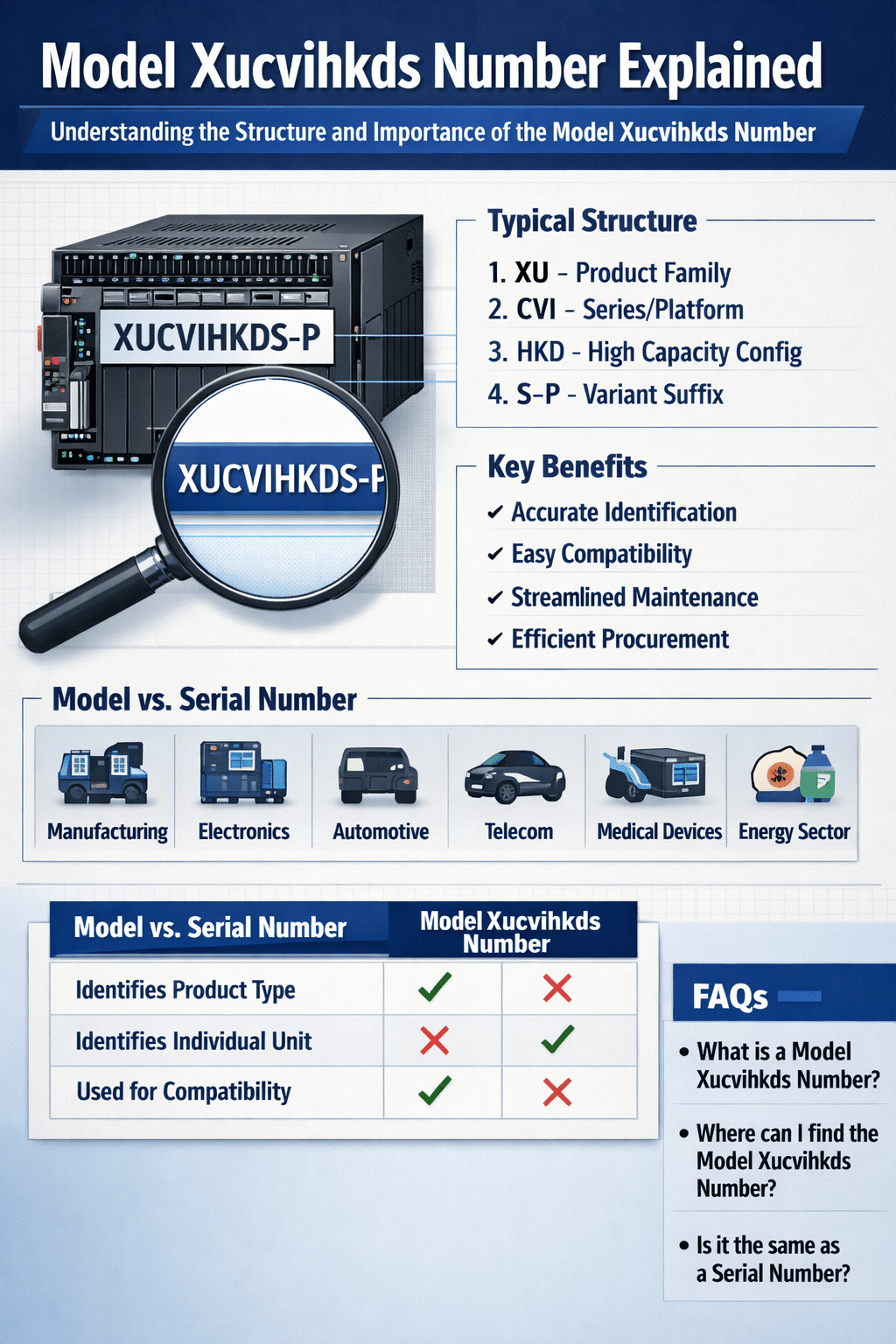
Typical Structure of a Model Xucvihkds Number
Although exact formats can vary by manufacturer, most model xucvihkds numbers follow a consistent logic pattern.
1. Product Family Identifier
The opening segment usually indicates the product category or family.
Example:
XU – Industrial control modules
XV – Embedded computing systems
This allows quick recognition of the general product type.
2. Series or Platform Code
This segment identifies the platform or generation.
Example:
CVI – Third-generation platform
Series codes often reflect performance tiers or design evolution.
3. Specification Block
Numbers or letters that describe technical characteristics, such as:
- Power rating
- Capacity
- Size class
- Processing capability
Example:
HKD – High-capacity digital configuration
4. Variant or Feature Suffix
Optional characters that show customization, region, or special features.
Example:
S – Standard
P – Professional
R – Ruggedized
Sample Breakdown
Model: XUCVIHKDS-P
- XU → Product family
- CVI → Platform series
- HKD → High-capacity configuration
- S → Standard variant
- P → Professional package
Each segment provides meaningful context for technical teams and buyers.
How to Locate the Model Xucvihkds Number
You can usually find the model xucvihkds number in several places:
- Product label or nameplate
- Packaging box
- User manual or quick-start guide
- Purchase invoice
- Manufacturer’s website
For digital products or software-driven systems, it may appear inside system settings or configuration menus.
Model Xucvihkds Number vs Serial Number
These two identifiers are often confused but serve different purposes.
| Feature | Model Xucvihkds Number | Serial Number |
| Identifies product type | Yes | No |
| Identifies individual unit | No | Yes |
| Same across identical units | Yes | No |
| Used for compatibility | Yes | No |
Think of the model number as the blueprint identity, while the serial number is the individual fingerprint.
Benefits of Using Model Xucvihkds Numbers Correctly
Improved Procurement Accuracy
Specifying the exact model xucvihkds number eliminates ambiguity when ordering or sourcing replacements.
Faster Technical Support
Support teams can instantly access correct documentation and troubleshooting procedures.
Streamlined Maintenance
Technicians know which parts, firmware, or accessories are compatible.
Better Inventory Control
Stock management systems can group and track identical products accurately.
Industries That Commonly Use Structured Model Numbers
The model xucvihkds number concept aligns with identification practices across many sectors:
- Manufacturing and automation
- Electronics and hardware
- Telecommunications
- Automotive systems
- Medical devices
- Energy and utilities
These industries often follow international standardization principles such as those promoted by the International Organization for Standardization, which emphasize consistent and interpretable product identification.
How to Verify a Model Xucvihkds Number
Before using or ordering a product:
- Compare with official documentation
- Check manufacturer databases
- Confirm format consistency
- Contact authorized distributors if uncertain
Avoid relying solely on third-party listings without verification.
Common Mistakes to Avoid
- Confusing similar characters (O vs 0, I vs 1)
- Using partial model numbers
- Ignoring suffixes that indicate variants
- Assuming two similar-looking models are interchangeable
Even minor differences can indicate major specification changes.
Best Practices for Businesses
- Store model numbers in centralized asset systems
- Include model xucvihkds number on purchase orders
- Train staff on reading and interpreting codes
- Standardize naming conventions across departments
These practices reduce errors and improve operational consistency.
Frequently Asked Questions
What is a model xucvihkds number?
A model xucvihkds number is an alphanumeric identifier that defines a product’s family, series, and configuration for accurate identification and compatibility.
Where can I find the model xucvihkds number?
It is usually printed on the product label, packaging, documentation, or listed in system settings for digital products.
Is the model xucvihkds number the same as a serial number?
No. The model number identifies the product type, while the serial number identifies an individual unit.
Why is the model xucvihkds number important?
It ensures correct ordering, maintenance, technical support, and compatibility verification.
Can two products share the same model xucvihkds number?
Yes. Products with identical specifications share the same model number but have different serial numbers.
Considerations
Model numbering systems are designed to be universally interpretable. The model xucvihkds number follows principles that work across global markets, regardless of language or region. This makes it suitable for multinational operations, international logistics, and cross-border technical support.
Conclusion
The model xucvihkds number is more than a simple identifier it is a structured communication tool that conveys critical product information. When understood and used correctly, it enhances accuracy, reduces risk, and supports efficient operations across technical and commercial environments.
Organizations that prioritize consistent use of model numbers gain better control over procurement, maintenance, and asset management.
If you need assistance documenting, standardizing, or integrating model xucvihkds numbers into your systems, consult with an experienced technical documentation or asset management professional to ensure long-term reliability and scalability.