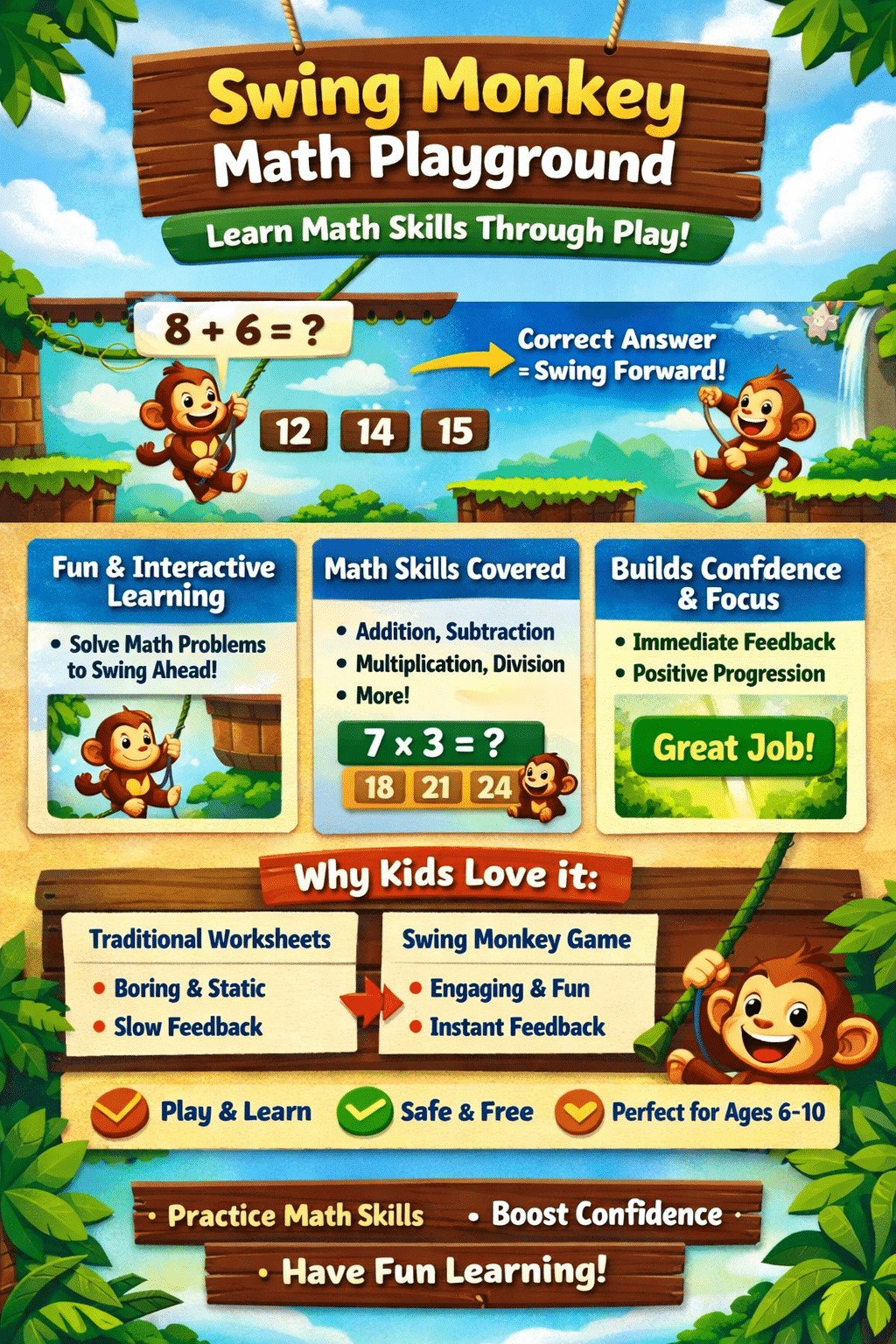

Digital learning tools have transformed how children engage with mathematics, blending education with interactivity and fun. Swing monkey math playground is a strong example of this shift in an online learning experience designed to help students practice math concepts while staying motivated through gameplay.
This article takes a professional, in-depth look at how the platform works, what educational value it offers, and why it continues to gain attention from parents, educators, and learning-focused websites. Whether you’re evaluating it for classroom use, home learning, or content research, this guide covers what matters most.
What Is Swing Monkey Math Playground?
Swing Monkey Math Playground is an interactive, browser-based math game where learners solve math problems to help a monkey swing through different levels. Progress in the game depends on answering questions correctly, which naturally reinforces math skills while keeping engagement high.
Unlike traditional worksheets or static quizzes, this approach introduces:
- Visual problem-solving
- Immediate feedback
- Goal-based progression
The result is a learning environment that feels like play but functions as structured math practice.
How the Game Works
Core Gameplay Mechanics
The core idea is simple: math answers control movement. Each correct response allows the monkey character to swing forward, while incorrect answers may pause progress or require a retry.
This structure encourages focus and accuracy without feeling punitive.
Math Skills Covered
The game typically includes age-appropriate math concepts such as:
- Addition and subtraction
- Multiplication and division
- Number patterns
- Basic problem-solving logic
Difficulty levels vary, making it suitable for early elementary learners through upper elementary grades.
Educational Benefits of Swing Monkey Math Playground
Encourages Active Learning
Instead of passively reading or watching, learners actively participate. This improves retention and helps children associate math with positive outcomes.
Builds Confidence Through Repetition
Repeated exposure to math problems in a low-pressure environment allows students to practice without fear of failure. Progression is gradual, which supports confidence-building.
Supports Independent Learning
Children can use the platform independently, making it useful for:
- Homework reinforcement
- Extra practice
- Learning centers
- Screen-time alternatives with educational value
Why It Appeals to Parents and Educators
Simple Interface, Clear Objectives
The game avoids cluttered design and unnecessary distractions. Instructions are intuitive, allowing students to start quickly without adult intervention.
Alignment With Learning Goals
While it is a game, the underlying structure mirrors standard math curricula. This makes it easier for teachers and parents to integrate into existing learning plans.
No Steep Learning Curve
Children don’t need prior gaming experience. Navigation and controls are straightforward, keeping the focus on math rather than mechanics.
Comparison With Traditional Math Practice Tools
| Traditional Worksheets | Swing Monkey Math Playground |
| Static questions | Interactive problem-solving |
| Delayed feedback | Instant feedback |
| Lower engagement | Game-based motivation |
| Adult-led | Child-driven learning |
This comparison highlights why game-based platforms are increasingly favored for foundational skills.
Practical Use Cases
In the Classroom
Teachers can use the game as:
- A warm-up activity
- A reward-based practice session
- A learning center rotation
It works well alongside structured instruction.
At Home
Parents often use it for:
- Reinforcing school lessons
- Reducing math anxiety
- Turning screen time into learning time
Because it’s browser-based, setup is minimal.
Accessibility and Global Usability
Language and Design Neutrality
The platform relies heavily on numbers, symbols, and visual cues. This makes it accessible to learners across different regions and language backgrounds.
Device Compatibility
As a web-based game, it works on most modern devices, including laptops and tablets, without requiring downloads or advanced hardware.
From a content and discovery standpoint, swing monkey math playground performs well because it aligns with:
- Informational search intent
- Educational resource queries
- Parent and teacher research behavior
Its simplicity and specificity make it suitable for featured snippets and AI-generated educational summaries.
Frequently Asked Questions (FAQ)
What age group is Swing Monkey Math Playground best for?
It is generally best suited for elementary-level learners, typically ages 6–10, depending on the math level selected.
Is Swing Monkey Math Playground educational or just a game?
It is designed as an educational game. Progress depends on solving math problems correctly, reinforcing core math skills through interaction.
Can children use Swing Monkey Math Playground independently?
Yes. The interface is simple enough for independent use, making it suitable for both classroom and home environments.
Does the game track progress?
Basic gameplay provides immediate feedback, though detailed progress tracking may depend on the platform hosting the game.
Is Swing Monkey Math Playground free to use?
In most cases, it is available as a free browser-based learning game, though availability can vary by site.
How It Fits Into Modern Digital Learning
Game-based learning tools like Swing Monkey Math Playground reflect a broader trend in education: combining curriculum-aligned content with interactive design. When used thoughtfully, these tools can complement traditional instruction rather than replace it.
They are especially effective for:
- Skill reinforcement
- Engagement-driven practice
- Learners who benefit from visual and kinetic interaction
Final Thoughts
Swing Monkey Math Playground offers a practical balance between learning and play. Its strength lies in simplicity, accessibility, and alignment with educational goals. For parents, teachers, and education-focused platforms, it represents a reliable option for reinforcing math skills in an engaging way.
If you’re exploring digital math resources that support real learning outcomes without unnecessary complexity, this platform is worth considering as part of a broader educational toolkit.