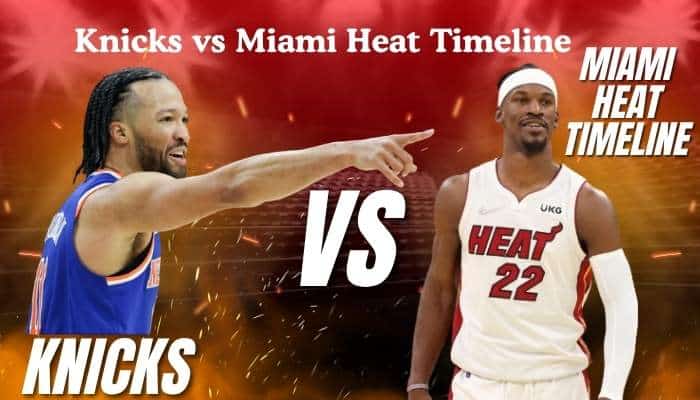

Introduction to the Knicks vs Miami Heat Timeline
The Knicks vs Miami Heat Timeline is one of the most intense rivalry stories in NBA history.
This matchup is famous for playoff wars, hard fouls, emotional fights, coaching drama, and classic games. It is not just another Eastern Conference matchup. It is a story of pride, revenge, pressure, and unforgettable playoff basketball.
From Patrick Ewing vs Alonzo Mourning in the 1990s to Jalen Brunson vs Jimmy Butler in 2023, the Knicks vs Miami Heat Timeline has given NBA fans several classic moments.
As of 2026, this rivalry still matters because both franchises have strong fan bases, deep playoff history, and a chance to create new chapters in the Eastern Conference.
Knicks vs Miami Heat Timeline
The Knicks vs Miami Heat Timeline covers the rivalry between the New York Knicks and Miami Heat from the 1990s to 2026. It became famous during four straight playoff meetings from 1997 to 2000. The rivalry includes the P.J. Brown and Charlie Ward incident, the Alonzo Mourning and Larry Johnson fight, Allan Houston’s 1999 game-winner, the LeBron-era Heat in 2012, and Miami’s 2023 playoff win over New York.
The teams are tied 3–3 in playoff series. Miami leads the all-time playoff game record 19–16.
Knicks vs Miami Heat Timeline
| Category | Detail |
| First playoff meeting | 1997 |
| Most intense era | 1997–2000 |
| Total playoff series | 6 |
| Playoff series record | Knicks 3, Heat 3 |
| Playoff game record | Heat 19, Knicks 16 |
| Most famous Knicks moment | Allan Houston’s 1999 shot |
| Most famous fight | Alonzo Mourning vs Larry Johnson |
| Latest playoff meeting | 2023 Eastern Conference Semifinals |
Why Knicks vs Heat Became One of the NBA’s Fiercest Rivalries
The Knicks vs Miami Heat Timeline became special because both teams played with the same mindset.
They were tough.
They defended hard.
They slowed the game down.
They made every possession feel important.
In the 1990s, Knicks vs Heat games often felt like battles. The scores were low. The fouls were hard. The crowds were loud. Every playoff game felt personal.
This rivalry had:
- Hard fouls
- Strong defense
- Emotional players
- Game 7 pressure
- Loud crowds
- Coaching tension
- Real bad blood
That is why fans still search for the Knicks vs Miami Heat Timeline today.
Pat Riley’s Impact on the Knicks vs Miami Heat Timeline
Pat Riley is one of the biggest reasons this rivalry became personal.
Riley coached the Knicks before leaving for Miami in 1995. His move added tension between the two franchises. Later, he helped shape Miami’s basketball culture around defense, toughness, discipline, and playoff focus.
That made Knicks vs Heat feel bigger than a normal matchup.
Both teams carried Riley-style traits:
- Tough defense
- Strong rebounding
- Physical basketball
- Mental toughness
- Slow playoff games
Without Pat Riley, the Knicks vs Miami Heat Timeline would not feel as emotional or historic.
Knicks vs Miami Heat Playoff Timeline
| Year | Round | Winner | Result | Main Story |
| 1997 | East Semifinals | Heat | 4–3 | Suspensions changed the series |
| 1998 | East First Round | Knicks | 3–2 | Mourning vs Johnson fight |
| 1999 | East First Round | Knicks | 3–2 | Allan Houston’s game-winner |
| 2000 | East Semifinals | Knicks | 4–3 | Another Game 7 battle |
| 2012 | East First Round | Heat | 4–1 | LeBron-era Heat dominated |
| 2023 | East Semifinals | Heat | 4–2 | Butler-led Heat beat Brunson’s Knicks |
The Knicks and Heat met in the playoffs four straight years from 1997 to 2000. New York won three of those four series. Miami later won the 2012 and 2023 playoff meetings.
1997: The Rivalry Explodes
The first major chapter in the Knicks vs Miami Heat Timeline came in 1997.
The Knicks led the Heat 3–1 in the Eastern Conference Semifinals. New York looked ready to win the series.
Then Game 5 changed everything.
P.J. Brown and Charlie Ward were involved in a major incident. Several Knicks players left the bench area, which led to suspensions. The Knicks lost key depth at the worst possible time.
Miami used the moment to fight back. The Heat won the series in seven games.
Why 1997 Mattered
This series changed the rivalry forever.
It gave Miami a dramatic comeback.
It gave New York a painful playoff memory.
It gave NBA fans a rivalry full of emotion.
The 1997 series turned the Knicks vs Miami Heat Timeline into must-watch basketball.
1998: Mourning vs Larry Johnson Fight
The next year, the Knicks got their chance for revenge.
The 1998 first-round series also went to a deciding game. But the most famous moment came before that.
In Game 4, Alonzo Mourning and Larry Johnson fought near the end of the game. Knicks coach Jeff Van Gundy tried to stop the fight and ended up holding Mourning’s leg.
That image became one of the most famous visuals in NBA rivalry history.
New York won Game 5 in Miami and eliminated the Heat.
Why 1998 Still Matters
The 1998 series proved the rivalry was not cooling down.
It had revenge.
It had fighting.
It had suspensions.
It had playoff pressure.
This chapter made the Knicks vs Miami Heat Timeline even more intense.
1999: Allan Houston’s Legendary Shot
The 1999 series gave Knicks fans one of their greatest playoff memories.
Miami was the No. 1 seed.
New York was the No. 8 seed.
The Heat were expected to win. But the Knicks pushed the series to Game 5.
1999 Game 5 Details
| Detail | Information |
|---|---|
| Date | May 16, 1999 |
| Arena | Miami Arena |
| Final Score | Knicks 78, Heat 77 |
| Attendance | 15,236 |
| Winning Shot | Allan Houston driving floater |
Late in the game, Allan Houston drove into the lane and released a running shot. The ball bounced off the rim, touched the backboard, and dropped in.
The Knicks won 78–77 and shocked Miami.
Why Allan Houston’s Shot Was So Important
That shot did more than win a game.
It helped the Knicks become one of the rare No. 8 seeds to upset a No. 1 seed. It also helped New York start a surprise run to the 1999 NBA Finals.
For many fans, this is the most famous moment in the Knicks vs Miami Heat Timeline.
2000: Another Seven-Game Battle
The Knicks vs Miami Heat Timeline continued in 2000.
For the fourth straight postseason, the Knicks and Heat met in the playoffs. This time, they faced each other in the Eastern Conference Semifinals.
Again, the series went to Game 7.
New York won in Miami and advanced. It was another tough, low-scoring, emotional playoff battle.
Why 2000 Was Important
The 2000 series proved this rivalry had staying power.
It was not based on one fight.
It was not based on one upset.
It was built through years of playoff pressure.
By the end of 2000, Knicks vs Heat had become one of the NBA’s defining rivalries of that era.
2012: LeBron James Adds a New Era to the Knicks vs Miami Heat Timeline
After more than a decade without a playoff meeting, the rivalry returned in 2012.
But this chapter looked different.
Miami had LeBron James, Dwyane Wade, and Chris Bosh. The Heat were chasing a championship. New York had Carmelo Anthony, Amar’e Stoudemire, and Tyson Chandler, but the Knicks could not match Miami’s talent and depth.
The Heat won the series 4–1. Miami later won the 2012 NBA championship.
What Changed in 2012
The old rivalry was about physical defense and fights.
The 2012 version was about star power.
LeBron controlled the series. Wade added scoring and pressure. Bosh helped Miami stay balanced. Carmelo carried much of New York’s offense, but Miami was clearly stronger.
This chapter added a new layer to the Knicks vs Miami Heat Timeline.
2023: Jimmy Butler Revives the Rivalry
The 2023 Eastern Conference Semifinals brought Knicks vs Heat back into the spotlight.
New York had Jalen Brunson, Julius Randle, and RJ Barrett. Miami had Jimmy Butler, Bam Adebayo, and Erik Spoelstra.
The Knicks had home-court advantage. But Miami stole Game 1 at Madison Square Garden. New York won Game 2, but the Heat controlled the middle of the series.
Miami closed out the Knicks in Game 6 with a 96–92 win.
Key Games From the 2023 Series
| Game | Winner | Score | Why It Mattered |
| Game 1 | Heat | 108–101 | Miami stole home-court advantage |
| Game 2 | Knicks | 111–105 | New York tied the series |
| Game 6 | Heat | 96–92 | Miami closed out the series |
The 2023 series gave the Knicks vs Miami Heat Timeline a modern chapter. It introduced younger fans to the same playoff tension older fans remembered from the 1990s.
Important 2026 Update in the Knicks vs Miami Heat Timeline
As of 2026, Jimmy Butler is no longer with the Miami Heat. He was traded to the Golden State Warriors in February 2025. NBA.com reported that Miami sent Butler to Golden State in a five-team deal.
This matters for accuracy.
But Butler is still a key figure in the Knicks vs Miami Heat Timeline because he led Miami past New York in the 2023 playoffs.
So, in 2026, the modern rivalry is better understood this way:
- Butler was central to the 2023 chapter.
- Bam Adebayo remains an important Heat figure.
- Jalen Brunson remains central to New York’s modern identity.
- Future Knicks vs Heat games may create a new rivalry chapter.
Madison Square Garden vs Miami Playoff Atmosphere
The Knicks vs Miami Heat Timeline is also about atmosphere.
Madison Square Garden gives Knicks vs Heat games an old-school NBA feeling. The crowd is loud, emotional, and deeply connected to Knicks history.
Miami’s home crowd has a different feel. Heat fans have seen championship teams. The organization also has a strong playoff identity.
Both arenas add pressure.
At MSG, every missed shot feels louder.
In Miami, the Heat play with confidence and calm.
That contrast makes the rivalry more interesting.
Most Famous Moments in the Knicks vs Miami Heat Timeline
Some moments define this rivalry more than others.
The biggest moments include:
- The P.J. Brown and Charlie Ward incident in 1997
- The Knicks suspensions in the 1997 series
- The Alonzo Mourning and Larry Johnson fight in 1998
- Jeff Van Gundy holding Mourning’s leg
- Allan Houston’s 1999 game-winner
- New York’s 2000 Game 7 win in Miami
- LeBron James leading Miami past New York in 2012
- Jimmy Butler leading Miami past New York in 2023
These moments made the Knicks vs Miami Heat Timeline more than a list of games. They made it a rivalry with emotion and memory.
Famous Quotes From the Knicks vs Miami Heat Timeline
The Knicks vs Miami Heat Timeline became memorable not only because of fights and playoff games, but also because of the emotion players and coaches brought to the rivalry.
1. Pat Riley
“The game has always been war.”
Pat Riley viewed playoff basketball as both a mental and physical battle. His coaching style helped shape the Knicks and Heat into tough defensive teams. That mindset became one of the biggest reasons the rivalry felt so intense during the 1990s.
2. Jeff Van Gundy
“I was trying to stop the fight.”
Jeff Van Gundy became part of NBA rivalry history during the 1998 Mourning vs Larry Johnson fight. His attempt to stop the fight by grabbing Mourning’s leg became one of the most replayed moments in NBA history.
3. Alonzo Mourning
“Those games were battles.”
Alonzo Mourning often described Knicks vs Heat playoff games as physical and emotional wars. His battles against Patrick Ewing helped define the rivalry’s identity.
4. Jimmy Butler
“We love playing in these environments.”
Jimmy Butler praised the playoff atmosphere during the 2023 Knicks vs Heat series. His leadership helped Miami eliminate New York and revive the rivalry for a modern NBA audience.
These quotes help explain why the Knicks vs Miami Heat Timeline still feels emotional and personal decades later.
Best Knicks vs Heat Games in the Knicks vs Miami Heat Timeline
1. 1999 Game 5
This is the most famous game in the rivalry. Allan Houston’s shot gave the Knicks a 78–77 win and ended Miami’s season.
2. 1997 Game 5
This game changed the 1997 series. The P.J. Brown and Charlie Ward incident led to suspensions and shifted momentum toward Miami.
3. 1998 Game 4
This game is remembered for the Mourning and Johnson fight. It became one of the most replayed moments in the rivalry.
4. 2000 Game 7
The Knicks won another winner-take-all game in Miami. It confirmed New York’s strong run against the Heat during that era.
5. 2023 Game 6
Miami beat New York 96–92 and closed out the series. It brought the rivalry back for a new generation.
Best Players in the Knicks vs Heat Rivalry
Several players shaped the Knicks vs Miami Heat Timeline.
Knicks Legends
1. Patrick Ewing
Patrick Ewing represented the toughness of 1990s Knicks basketball. His battles with Alonzo Mourning became one of the defining parts of the Knicks vs Miami Heat Timeline. Ewing’s physical style and leadership helped turn every playoff matchup into a defensive war.
2. Allan Houston
Allan Houston created one of the most unforgettable moments in Knicks history with his 1999 game-winning shot against Miami. His floater over the Heat helped New York complete one of the greatest playoff upsets in NBA history.
3. Larry Johnson
Larry Johnson brought toughness, energy, and emotion to the Knicks during the rivalry years. His 1998 fight with Alonzo Mourning became one of the most replayed moments in NBA playoff history. Johnson’s aggressive style perfectly matched the physical identity of the Knicks during the late 1990s.
4. Latrell Sprewell
Alonzo Mourning was the emotional leader of the Miami Heat during the rivalry’s most intense years. His battles with Patrick Ewing helped define the defensive identity of Knicks vs Heat basketball. Mourning’s intensity, rim protection, and competitive personality made him one of the central figures in the rivalry.
5. Carmelo Anthony
1. Alonzo Mourning
Alonzo Mourning was the emotional and defensive leader of the Miami Heat during the rivalry’s most intense years. His physical battles with Patrick Ewing helped define the identity of the Knicks vs Miami Heat Timeline. Mourning’s rim protection, toughness, and competitive personality made every playoff matchup feel personal and emotional.
2. Tim Hardaway
Tim Hardaway was Miami’s main playmaker during the early rivalry years. His ball handling, scoring ability, and leadership helped the Heat compete with New York during several intense playoff battles. Hardaway’s partnership with Alonzo Mourning became one of the key reasons Miami emerged as a major Eastern Conference power in the late 1990s.
3. P.J. Brown
P.J. Brown became one of the most controversial figures in the rivalry because of the famous 1997 incident involving Charlie Ward. That moment changed the direction of the playoff series after several Knicks players received suspensions. Brown’s physical playing style reflected the tough and aggressive identity of the Heat during that era.
4. LeBron James
LeBron James dominated the 2012 playoff matchup and helped Miami control the series against New York. His scoring, playmaking, and defensive versatility showed why the Heat were one of the NBA’s strongest championship teams. LeBron’s performances added a superstar era to the Knicks vs Miami Heat Timeline.
5. Dwyane Wade
Dwyane Wade brought scoring, leadership, and championship experience to Miami during the 2012 playoff series. His ability to attack the basket and create pressure on defense helped the Heat overwhelm New York in key moments. Wade’s partnership with LeBron James gave Miami one of the league’s most dangerous playoff teams.
6. Jimmy Butler
Jimmy Butler helped revive the rivalry for a modern NBA audience during the 2023 playoffs. His leadership, confidence, and playoff toughness allowed Miami to eliminate New York in six games. Butler embraced the pressure of playing at Madison Square Garden and added another memorable chapter to the Knicks vs Miami Heat Timeline.
7. Bam Adebayo
The 1990s rivalry was built on physical defense.
Teams played slower. Big men controlled the paint. Hard fouls were common. Every game felt like a fight for space.
The modern NBA is different.
Today, teams use more spacing, three-point shooting, and faster offense. Players attack from the perimeter more often. The game is less physical than it was in the 1990s.
| Category | 1990s Rivalry | Modern Rivalry |
|---|---|---|
| Pace | Slow | Faster |
| Average Scores | Lower | Higher |
| Defensive Focus | Extremely physical | More spacing-focused |
| Three-Point Shooting | Limited | Heavy usage |
| Paint Play | Dominant | More perimeter play |
| Playoff Style | Defensive battles | Faster offense |
Still, the emotion remains.
That is why the Knicks vs Miami Heat Timeline still works for modern fans. The style has changed, but the pressure has not.
Why the Knicks vs Miami Heat Timeline Still Matters in 2026
The Knicks vs Miami Heat Timeline still matters because it has real history.
Many rivalries are remembered for one series. Knicks vs Heat has several.
It includes:
- Four straight playoff meetings
- Multiple Game 7 battles
- Famous fights
- A No. 8 seed upset
- Coaching tension
- Big-market attention
- Modern playoff drama
It also matters because both teams still have strong identities.
The Knicks carry Madison Square Garden pressure. The Heat carry playoff culture and discipline. When these teams meet, fans remember the past.
Rivalry Statistics
| Stat | Result |
| Total playoff series | 6 |
| Playoff series record | 3–3 |
| Heat playoff game wins | 19 |
| Knicks playoff game wins | 16 |
| Most intense era | 1997–2000 |
| Most famous Knicks moment | Allan Houston’s 1999 shot |
| Most famous Heat comeback | 1997 series |
| Latest playoff meeting | 2023 Eastern Conference Semifinals |
The playoff record gives Miami a slight game-by-game edge, but the series history is even. That balance is one reason the Knicks vs Miami Heat Timeline remains so interesting.
Historical Accuracy Note
This article is based on publicly available NBA playoff records, Basketball Reference playoff series pages, NBA historical coverage, and rivalry records reviewed in 2026.
Some sections, such as “best games” and “most famous moments,” include editorial judgment. They are ranked based on playoff importance, fan memory, historical impact, and rivalry relevance.
Conclusion
The Knicks vs Miami Heat Timeline is one of the most dramatic rivalry stories in NBA history.
It has playoff wars, famous fights, Game 7 pressure, emotional fan bases, and classic moments. It also has a rare balance. The teams are tied in playoff series, but Miami has a small edge in total playoff wins.
From the 1997 fight and suspensions to Allan Houston’s 1999 winner, the 2000 Game 7 battle, the 2012 LeBron-era matchup, and the 2023 playoff revival, this rivalry has stayed memorable.
For NBA fans, the Knicks vs Miami Heat Timeline is not just about scores. It is about toughness, revenge, heartbreak, and classic playoff basketball.
Knicks vs Miami Heat Timeline FAQs
1. Why is the Knicks vs Miami Heat Timeline considered one of the NBA’s best rivalries?
The Knicks vs Miami Heat Timeline is considered one of the NBA’s best rivalries because of its playoff intensity, physical games, famous fights, Game 7 battles, and emotional fan reactions across multiple generations.
2. Which playoff series was the most important in the Knicks vs Miami Heat Timeline?
Many fans consider the 1999 playoff series the most important chapter in the Knicks vs Miami Heat Timeline because Allan Houston’s game-winning shot helped New York upset the No. 1 seed Heat.
3. How did Pat Riley influence the Knicks vs Miami Heat Timeline?
Pat Riley influenced the Knicks vs Miami Heat Timeline by coaching both franchises and building defensive, physical basketball cultures that made the rivalry more emotional and competitive.
4. Why do NBA fans still search for the Knicks vs Miami Heat Timeline in 2026?
Fans still search for the Knicks vs Miami Heat Timeline in 2026 because the rivalry connects classic 1990s playoff battles with modern NBA stars like Jalen Brunson and Jimmy Butler.
5. What made the 1990s Knicks vs Heat games so physical?
The 1990s games in the Knicks vs Miami Heat Timeline were physical because both teams focused heavily on defense, rebounding, paint control, and emotional playoff basketball.
6. Which arena had the better playoff atmosphere in the Knicks vs Miami Heat Timeline?
Many NBA fans believe Madison Square Garden had the louder atmosphere, while Miami created a strong championship-style playoff environment during key rivalry moments in the Knicks vs Miami Heat Timeline.
7. Could the Knicks vs Miami Heat Timeline add another playoff chapter soon?
Yes. Many analysts believe the Knicks vs Miami Heat Timeline could continue growing because both teams remain important Eastern Conference franchises with strong playoff expectations.