
Gap insurance exclusions play a critical role in determining whether your policy will actually protect you in a financial emergency. While many car buyers believe gap insurance covers all remaining loan amounts after a total loss, the reality is more complex. Insurers include specific limitations to manage risk, which means coverage applies only under certain conditions. Understanding gap insurance exclusions helps you avoid costly surprises and ensures you are not left paying out of pocket after an accident.
In most cases, these exclusions are tied to policy compliance, loan structure, and driver behavior. For example, missed payments, inactive policies, or unauthorized vehicle use can all lead to claim denial. These restrictions are not random but are based on common risk factors observed by insurance providers. By being aware of how gap insurance exclusions work, policyholders can take proactive steps to maintain eligibility and avoid rejection during the claims process.
From a financial planning perspective, these limitations highlight the importance of reading and understanding your policy before relying on it. Many buyers focus only on the benefits and overlook the restrictions, which can lead to serious financial consequences. Knowing how gap insurance exclusions affect your coverage allows you to make smarter decisions, choose the right policy type, and reduce the risk of unexpected liabilities in the future.
What Are Gap Insurance Exclusions
Gap insurance exclusions are specific situations where your policy will not pay, even if your vehicle is damaged or declared a total loss.
Gap insurance is designed to cover the difference between your vehicle’s actual cash value and the remaining loan balance. However, this protection applies only under defined conditions and does not extend to all financial liabilities.
In practical terms, gap insurance exclusions define the boundaries of your coverage and determine when the policy becomes ineffective. Many policyholders assume that any financial gap will be covered, but insurers carefully structure these exclusions to manage financial risk and prevent misuse. Understanding gap insurance exclusions early helps you align your insurance, loan, and usage conditions properly.
- Gap insurance exclusions are often linked to loan structure, policy status, and vehicle usage
- These exclusions are based on real claim patterns and insurer risk management practices
- Awareness of exclusions can significantly reduce the chances of claim denial
Types of Gap Insurance
There are different types of gap insurance policies, and exclusions can vary depending on the type
- Finance Gap Insurance
Covers the difference between the loan balance and insurance payout - Return to Invoice Gap Insurance
Covers the difference between payout and original purchase price - Vehicle Replacement Gap Insurance
Covers the cost of replacing your car with a new equivalent model
Choosing the right type is important because coverage limits and exclusions differ between policies.
Each type of policy is designed to address a different financial scenario, which means the impact of gap insurance exclusions can vary depending on the coverage you choose. For example, some policies may offer broader protection for depreciation, while others strictly limit payouts based on loan terms and vehicle valuation.
- Finance-based policies focus on loan balance protection
- Invoice-based policies offer higher coverage but may have stricter conditions
- Replacement policies aim for value protection but depend heavily on eligibility criteria
Why Gap Insurance Exclusions Matter
Ignoring exclusions can lead to serious financial consequences
- You may continue paying a loan for a vehicle you no longer own
- Your claim may be rejected even after a total loss
- You may face unexpected out-of-pocket expenses
Gap insurance is not comprehensive protection. It is conditional and works only within defined boundaries.
From a real-world financial perspective, gap insurance exclusions directly impact how much risk you carry after financing a vehicle. Many borrowers focus on monthly payments and overlook how quickly depreciation can create a financial gap. When exclusions apply, the burden shifts back to the policyholder, making awareness of gap insurance exclusions essential for long-term financial planning.
- Gap insurance exclusions often apply during high-risk scenarios like early loan years
- Financial exposure increases when vehicle depreciation outpaces loan repayment
- Understanding exclusions helps reduce unexpected debt after a total loss
When Gap Insurance Will Pay
Gap insurance will pay only when all conditions are met
- The vehicle is declared a total loss
- Your primary insurance pays the claim
- Your policy is active at the time of loss
- Your loan is valid and up to date
If any of these conditions are not satisfied, the claim may be denied.
In practice, insurers evaluate multiple factors before approving a claim, not just the accident itself. Gap insurance exclusions can still apply even when the loss seems valid, especially if there are gaps in documentation or policy compliance. This makes it important for policyholders to maintain consistency across insurance coverage, loan payments, and usage conditions.
- Claim approval depends on both insurance records and loan history
- Delays or mismatches in documentation can affect payout eligibility
- Staying compliant with policy terms reduces the risk of rejection
Complete List of Gap Insurance Exclusions
1. Not a Total Loss
Gap insurance only applies when the vehicle is declared a total loss
- Minor accidents are not covered
- Repairable damage is not covered
One of the most important gap insurance exclusions is that coverage applies strictly to total loss situations. Even if repair costs are high, insurers will not pay unless the vehicle is officially classified as a total loss based on valuation guidelines. This ensures that gap insurance is used only for significant financial gaps, not routine repair scenarios.
- Total loss is determined by insurer assessment, not repair cost alone
- High repair bills do not automatically qualify for gap coverage
- Depreciation gap matters only when the vehicle is written off
2. No Primary Insurance Payout
Gap insurance depends on your main insurance policy
- If your primary insurer denies the claim
- Gap insurance will not pay
Gap insurance exclusions clearly state that it works as secondary coverage, meaning it activates only after your primary insurance settles the claim. If your base policy is invalid or the claim is rejected due to policy violations, gap insurance will not provide any financial support.
- Gap insurance cannot function without a valid primary insurance payout
- Policy violations in main insurance affect gap eligibility
- Maintaining full coverage is essential for claim approval
3. Policy Lapse or Inactive Coverage
If your policy is inactive
- Missed premium payments
- Expired insurance
Your claim will be rejected
Another critical aspect of gap insurance exclusions is continuous policy validity. Insurance companies require active coverage at the time of loss, and even a short lapse can result in claim denial. This makes timely premium payments and policy renewal extremely important.
- Active policy status is mandatory at the time of claim
- Even temporary lapses can void coverage
- Consistent premium payments ensure eligibility
4. Negative Equity from Previous Loans
Gap insurance does not cover previous debt
- Old loan balances rolled into a new loan are excluded
- Only the current loan balance is covered
One of the most misunderstood gap insurance exclusions is related to negative equity. When buyers roll an old loan into a new car loan, the total borrowed amount increases beyond the actual vehicle value. Gap insurance is designed to cover only the current vehicle’s value gap, not past financial obligations, which means this extra debt remains your responsibility.
- Loan rollover increases financial risk but is not covered by gap insurance
- Only the portion directly tied to the current vehicle is eligible
- Higher loan-to-value ratios can increase out-of-pocket costs
5. Missed or Late Loan Payments
Gap insurance excludes additional financial charges
- Late payment fees
- Missed installments
- Accrued interest
Another important part of gap insurance exclusions involves payment discipline. If your loan balance increases due to missed payments or penalties, gap insurance will not cover those additional charges. Insurers calculate payouts based on the agreed loan structure, not inflated balances caused by delays or defaults.
- Payment history directly impacts claim eligibility
- Extra charges are considered borrower responsibility
- Maintaining timely payments helps preserve full coverage benefits
6. Mechanical Failure and Maintenance
Gap insurance is not a repair or maintenance policy
- Engine issues are not covered
- Tire wear is not covered
- Routine servicing is not covered
Gap insurance exclusions clearly separate financial protection from vehicle maintenance. Mechanical failures or wear and tear are considered part of regular vehicle ownership and are not linked to total loss scenarios. This ensures that gap insurance remains focused on loan-related financial gaps rather than operational issues.
- Maintenance costs fall under ownership responsibility
- Extended warranties are needed for mechanical protection
- Gap insurance applies only to depreciation-related loss
7. Fraud or Misrepresentation
If false information is provided
- Incorrect loan details
- False claims
The policy becomes invalid and claims are denied
Fraud-related gap insurance exclusions are strictly enforced by insurers. Any form of misrepresentation, whether intentional or accidental, can lead to immediate claim denial and policy cancellation. Insurance providers rely heavily on accurate documentation, making transparency essential throughout the policy lifecycle.
- Accurate documentation is required at all stages of the policy
- Misrepresentation can void both primary and gap coverage
- Honest disclosure ensures smoother claim processing
8. Illegal Activities or Negligence
Gap insurance excludes incidents involving
- Driving under the influence
- Reckless driving or racing
- Criminal activity
Gap insurance exclusions clearly state that coverage will not apply if the loss occurs due to illegal or negligent behavior. Insurers classify these situations as preventable risks, and therefore, they fall outside the scope of financial protection. Even if the vehicle is declared a total loss, claims can be denied if policy terms are violated.
- Policy compliance is essential for claim approval
- Illegal activities automatically void coverage eligibility
- Responsible driving behavior reduces claim rejection risk
9. Unauthorized Drivers
If an unapproved driver uses the vehicle
- The claim may be rejected
- Coverage applies only to listed drivers
Another important aspect of gap insurance exclusions is driver eligibility. Insurance policies are based on risk assessment, which includes who is allowed to operate the vehicle. If someone not listed on the policy is driving at the time of the incident, insurers may deny the claim due to increased and unassessed risk.
- Only approved drivers are covered under the policy
- Unauthorized usage can lead to claim denial
- Updating driver details helps maintain coverage validity
10. Commercial or Business Use
Most gap policies are designed for personal use
- Ride sharing is not covered
- Delivery services are not covered
- Business usage is excluded
Gap insurance exclusions also apply when the vehicle is used beyond personal purposes. Commercial activities increase wear, risk, and exposure, which are not included in standard policies. Without specific commercial coverage, claims related to such usage are likely to be denied.
- Business use increases risk beyond personal policy limits
- Specialized coverage is required for commercial usage
- Misuse of vehicle purpose can invalidate claims
11. Vehicle Modifications and Add ons
Gap insurance usually excludes
- Custom modifications
- Aftermarket accessories
- Non factory installations
Gap insurance exclusions typically limit coverage to the original manufacturer value of the vehicle. Modifications and add-ons may increase the vehicle’s cost, but they are not always recognized in the insured value. As a result, these enhancements are often excluded from claim calculations.
- Coverage is based on standard vehicle valuation
- Modifications may require separate insurance
- Non factory additions are usually not included in payout
12. Deductibles and Additional Charges
Gap insurance may not fully cover
- Insurance deductibles
- Lease penalties
- Administrative fees
Another key part of gap insurance exclusions is the limitation on extra financial charges. While gap insurance covers the difference between value and loan, it may not include additional costs associated with the claim or contract. These charges are often the responsibility of the policyholder.
- Deductibles may be partially covered depending on policy
- Extra fees are typically excluded from payout
- Reviewing policy terms helps avoid unexpected costs
13. Ineligible Vehicles
Some vehicles may not qualify
- Older vehicles
- High mileage vehicles
- Commercial vehicles
Gap insurance exclusions also depend on vehicle eligibility criteria. Insurers set limits based on age, condition, and usage of the vehicle. Vehicles that fall outside these criteria may not qualify for coverage at all, making it important to verify eligibility before purchasing a policy.
- Eligibility depends on insurer guidelines and vehicle condition
- Older or heavily used vehicles carry higher risk
- Checking requirements ensures proper coverage selection
Gap Insurance Claim Reality and Industry Insight
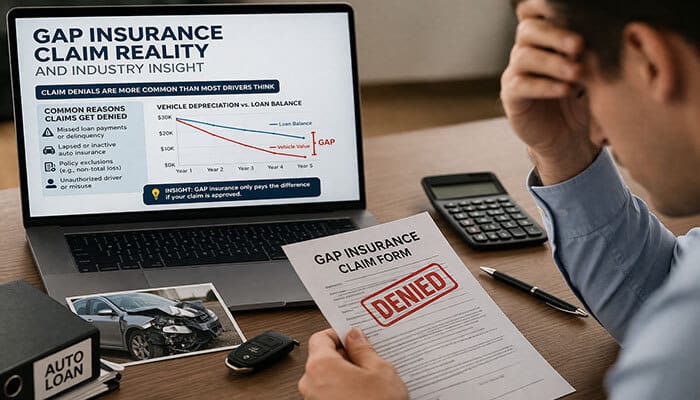
From an industry perspective, gap insurance is designed as a risk-limited financial product, not a full protection policy.
Vehicle depreciation plays a major role in its necessity. On average, a new car can lose 20 percent to 30 percent of its value within the first year, and up to 50 percent within three years. This depreciation gap is what gap insurance aims to cover.
However, insurers apply strict exclusions to control risk exposure. Claims are commonly denied due to
- Inactive policies
- Lack of primary insurance coverage
- Loan irregularities
- Policy violations
Understanding these factors helps explain why exclusions exist and how insurers manage financial risk.
From a deeper industry standpoint, gap insurance exclusions are structured based on real claim data and loss patterns observed over time. Insurers analyze high-risk behaviors and financial inconsistencies to define when coverage should not apply. This ensures that gap insurance remains a controlled financial tool rather than an open-ended liability for insurers.
- Gap insurance exclusions are designed using real-world claim trends and risk modeling
- Early loan periods carry the highest exposure due to faster depreciation
- Financial discipline and policy compliance significantly improve claim approval chances
How Much Does Gap Insurance Cost
Gap insurance cost depends on the provider, vehicle type, and loan structure
- Dealership pricing is typically higher
- Insurance providers often offer lower cost options
- Payment can be one time or added to your insurance premium
Typical cost range
- Around 2 percent to 7 percent of the vehicle value
In many cases, buying gap insurance through an insurer rather than a dealership can reduce costs.
From a financial planning perspective, the cost of gap insurance should be compared against potential loss rather than just price alone. In high depreciation scenarios or long-term loans, even a small premium can prevent significant financial burden. Understanding how gap insurance exclusions affect payouts is equally important when evaluating whether the cost provides real value.
- Lower premiums may come with stricter gap insurance exclusions
- Comparing multiple providers helps identify better coverage terms
- Cost effectiveness depends on loan size, tenure, and depreciation risk
Pros and Cons of Gap Insurance Exclusions
Pros
- Protects against rapid depreciation
- Reduces financial burden after total loss
- Useful for long term auto loans
Cons
- Limited coverage due to exclusions
- Does not cover repairs or maintenance
- May not be necessary for all buyers
From a practical standpoint, the value of gap insurance depends on your financial situation and risk exposure. While it offers strong protection in high-risk scenarios, gap insurance exclusions can limit its usefulness if policy conditions are not met. Evaluating both advantages and limitations ensures you make a balanced and informed decision.
- Best suited for high loan-to-value financing situations
- Less beneficial when equity in the vehicle is already strong
- Understanding exclusions helps maximize the real benefit of coverage
Who Should Not Buy Gap Insurance Exclusions
Gap insurance may not be necessary if
- You made a large down payment
- Your loan balance is low
- Your car value exceeds your loan
- You purchased the vehicle without financing
From a financial perspective, gap insurance is most useful when there is a significant difference between the loan balance and the vehicle’s value. If that gap is minimal or does not exist, paying for additional coverage may not provide meaningful benefits. In such cases, understanding gap insurance exclusions becomes even more important, as the policy may offer limited value relative to its cost.
- Buyers with strong equity in their vehicle face lower financial risk
- Short loan terms reduce the impact of depreciation over time
- Reviewing gap insurance exclusions helps determine whether coverage is truly necessary
Making the right decision depends on evaluating your loan structure, depreciation risk, and overall financial exposure.
Real Life Example
Consider this scenario
- Loan amount is 10 lakh
- Vehicle value after accident is 7 lakh
- Insurance payout is 7 lakh
- Gap insurance covers remaining 3 lakh
However
- Previous loan of 1.5 lakh is excluded
- Late fees of 50 thousand are excluded
You still pay 2 lakh out of pocket
This example clearly shows how gap insurance exclusions can impact your final financial outcome. Even when the policy works as expected, certain components of your loan are not included in the coverage. Many policyholders assume the entire outstanding amount will be paid, but exclusions related to previous debt and additional charges often create a financial gap.
- Gap insurance exclusions apply only to eligible loan portions
- Additional financial liabilities remain the borrower’s responsibility
- Understanding exclusions helps set realistic expectations before purchasing a policy
Hidden Gap Insurance Exclusions
Many policyholders overlook these critical exclusions
- Loan rollover balances
- Policy violations
- Driver eligibility requirements
- Business use restrictions
These are among the leading causes of claim denial.
In many cases, gap insurance exclusions are not prominently highlighted during the purchase process, which can lead to confusion at the time of claim. These hidden conditions are usually detailed in policy documents and can significantly affect coverage eligibility. Being aware of these lesser-known exclusions helps you avoid unexpected claim rejection and ensures better financial planning.
- Hidden exclusions often appear in detailed policy terms and conditions
- Misunderstanding these exclusions can lead to denied claims
- Reviewing policy documents carefully reduces future risk
Internal Linking Opportunities
To improve SEO and topical authority, connect this article with related content such as
- Car insurance guide
- Auto loan guide
- Vehicle depreciation article
Internal linking is a powerful SEO strategy that helps search engines understand the context and relevance of your content. By linking this article on gap insurance exclusions to related topics, you create a stronger content network that improves visibility, user engagement, and ranking potential.
- Linking to a car insurance guide helps explain how primary coverage affects gap insurance exclusions
- Connecting to an auto loan guide provides deeper insight into loan structures and financial risk
- Referencing a vehicle depreciation article supports understanding of value loss and coverage gaps
Conclusion
Gap insurance exclusions define the true boundaries of your coverage and play a crucial role in determining your financial protection after a total loss. While gap insurance can help cover the difference caused by depreciation, it does not eliminate all financial risks. Understanding gap insurance exclusions ensures you are aware of situations where coverage may not apply, helping you avoid unexpected out-of-pocket expenses.
From a practical perspective, gap insurance exclusions highlight the importance of looking beyond policy benefits and focusing on real coverage limitations. Many policyholders overlook these exclusions and assume full protection, which can lead to claim denials and financial stress. Being informed about gap insurance exclusions allows you to align your insurance decisions with your loan structure and overall financial planning.
Ultimately, gap insurance exclusions should be viewed as a guide to making smarter and more informed decisions. By understanding how these exclusions work, you can choose the right policy, maintain compliance with terms, and reduce financial uncertainty. This awareness ensures that your gap insurance provides meaningful protection when you need it most.
Gap Insurance Exclusions FAQS
1. What are gap insurance exclusions and why do they matter
Gap insurance exclusions are specific conditions where your policy will not provide coverage. They matter because they determine whether your claim will be approved or denied, especially in total loss situations.
2. Do gap insurance exclusions apply even after a total loss
Yes, gap insurance exclusions can still apply even if your vehicle is declared a total loss. If policy conditions such as active coverage or valid primary insurance are not met, your claim may be rejected.
3. How do gap insurance exclusions affect loan repayment
Gap insurance exclusions can leave you responsible for certain parts of your loan, such as negative equity, late fees, or penalties. This means you may still owe money even after receiving an insurance payout.
4. Can gap insurance exclusions vary between providers
Yes, gap insurance exclusions can vary depending on the insurer and policy type. Different providers may have different rules regarding coverage limits, eligibility, and excluded situations.
5. How can I avoid issues related to gap insurance exclusions
You can avoid problems with gap insurance exclusions by maintaining active insurance, making timely loan payments, understanding policy terms, and ensuring compliance with all coverage conditions.
Disclaimer