
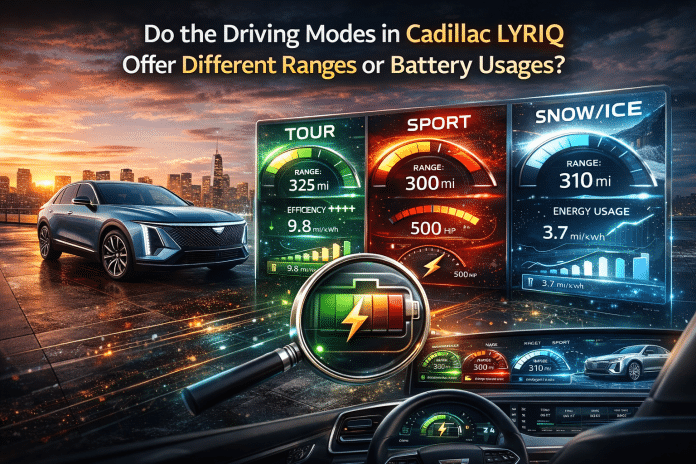

Electric vehicle owners increasingly expect their cars to adapt to different driving needs, from relaxed commuting to long-distance travel and dynamic highway performance. Driving modes promise to tailor vehicle behavior to these contexts, but many drivers are unsure how much these modes actually change energy use and real-world range.
This uncertainty is especially relevant for premium electric vehicles, where software-defined features influence efficiency as much as hardware. Understanding how driving modes affect battery consumption can help owners make smarter choices that extend usable range without compromising comfort or safety.
This article answers a common and practical question: do the driving modes in Cadillac Lyriq offer different ranges or battery usages? The goal is to explain the mechanics behind driving modes in clear terms, explore real-world implications, and offer strategic guidance for maximizing efficiency across everyday and long-distance driving scenarios.
Throughout the discussion, the focus is on how mode selection shapes energy demand, how those differences translate into measurable range variation, and how drivers can use this knowledge to make informed decisions over the vehicle’s lifecycle.
Understanding How Driving Modes Influence Energy Use
Driving modes are software profiles that change how an electric vehicle responds to driver inputs and operating conditions. These profiles adjust parameters such as throttle mapping, regenerative braking intensity, steering response, suspension tuning, and climate system behavior. While the battery and motor hardware remain the same, the way power is requested and recovered changes meaningfully across modes.
At a system level, energy consumption in an electric vehicle is driven by three main factors: how aggressively power is delivered to the motors, how efficiently kinetic energy is recovered during deceleration, and how much auxiliary power is consumed by systems like climate control. Driving modes influence all three.
When a mode softens throttle response, it reduces peak power draw during acceleration. When it increases regenerative braking, it recovers more energy that would otherwise be lost as heat. When it moderates climate control behavior, it reduces auxiliary load on the battery. These adjustments do not create energy from nothing, but they change how much of the stored energy is converted into forward motion versus lost to inefficiencies.
This is the foundation for understanding why mode selection can influence usable range in practice.
How the Driving Modes Are Designed to Behave
To assess whether do the driving modes in Cadillac Lyriq offer different ranges or battery usages?, it helps to understand the design intent behind typical electric vehicle driving modes.
Most premium electric vehicles include at least three broad categories of modes: an efficiency-oriented mode, a balanced everyday mode, and a performance-oriented mode. Each category reflects a different priority.
Efficiency-focused modes prioritize smoothness and energy recovery. Throttle response is more progressive, which discourages sudden power spikes. Regenerative braking is typically stronger, allowing more energy to flow back into the battery when the driver lifts off the accelerator. Climate control may be optimized to reduce energy draw during heating or cooling.
Balanced modes aim to provide a natural driving feel without overtly prioritizing efficiency or performance. Power delivery feels responsive but not aggressive. Regeneration is tuned to feel predictable rather than maximally strong. Auxiliary systems operate in a way that prioritizes comfort without excessive energy savings.
Performance-oriented modes sharpen throttle response, reduce regenerative braking intervention to allow coasting, and enable more aggressive motor output. These modes are designed to provide immediate power and dynamic response, which increases instantaneous energy draw from the battery.
These differences are not cosmetic. They change how the vehicle uses energy minute by minute, which accumulates into meaningful differences in battery usage over longer trips.
Measurable Range Differences in Real-World Conditions
When drivers ask whether do the driving modes in Cadillac Lyriq offer different ranges or battery usages?, they are often looking for a simple answer. The reality is nuanced. The driving modes do not change the battery’s capacity, but they influence how quickly that capacity is consumed.
In controlled testing environments, efficiency-oriented modes tend to yield modest but measurable improvements in range, particularly in urban and mixed driving conditions. The improvement does not come from slower top speeds or artificial limitations, but from smoother power delivery and more consistent energy recovery during braking.
In real-world usage, the range difference between modes can vary based on driving style, terrain, traffic patterns, and climate conditions. In stop-and-go urban driving, stronger regenerative braking in an efficiency-oriented mode can recover more energy, resulting in lower net battery usage per kilometer or mile. On highways, the difference may be smaller, because steady cruising minimizes opportunities for regeneration and throttle mapping differences become less pronounced.
Performance-oriented modes tend to consume more energy over the same distance, especially when drivers take advantage of sharper acceleration. The additional energy use is not inherently wasteful; it reflects a deliberate trade-off between responsiveness and efficiency. Over long distances, however, this trade-off can translate into fewer kilometers or miles of usable range before recharging is required.
The practical implication is that range variation across modes is situational rather than absolute. Drivers who maintain gentle inputs in any mode may see similar consumption, while drivers who exploit the full responsiveness of performance-oriented modes will likely experience faster battery depletion.
Battery Usage Patterns Across Typical Driving Scenarios
Battery usage is best understood by looking at scenarios rather than isolated mode labels. The question of whether do the driving modes in Cadillac Lyriq offer different ranges or battery usages? becomes clearer when framed in terms of daily driving contexts.
In urban commuting, frequent stops create opportunities for regenerative braking to recover energy. Modes that emphasize regeneration can materially reduce net energy consumption. Over a full workweek of short trips, this can add up to noticeable savings in battery usage.
In suburban mixed driving, where speeds vary and traffic patterns are inconsistent, the difference between modes becomes more dependent on driver behavior. Efficiency-oriented throttle mapping can help smooth out acceleration patterns, leading to more consistent consumption. Balanced modes may feel more natural, but the underlying energy use is often slightly higher if acceleration is less restrained.
On highways, steady cruising dominates energy use. Here, the difference between modes is narrower, because regenerative braking plays a smaller role. However, performance-oriented modes can still lead to higher consumption if drivers use more aggressive acceleration for overtaking or frequent speed changes.
In cold or hot climates, auxiliary energy use for heating or cooling becomes significant. Some modes manage climate systems more conservatively, which can reduce overall battery draw. In these conditions, the mode’s impact on auxiliary systems can influence range as much as throttle or regeneration settings.
Common Misconceptions About Driving Modes and Range
One frequent misconception is that selecting a particular driving mode automatically guarantees a fixed percentage increase or decrease in range. In reality, the mode sets behavioral parameters, but the driver’s inputs still dominate actual energy use.
Another misconception is that performance-oriented modes are inherently inefficient at all times. These modes enable higher power output, but they do not force the vehicle to consume more energy unless the driver requests that power. A disciplined driver can achieve relatively efficient driving even in a performance-oriented mode by maintaining smooth inputs and steady speeds.
Some drivers also assume that efficiency-oriented modes compromise safety or drivability. In practice, these modes are engineered to maintain full safety system functionality and adequate responsiveness for everyday driving. The difference lies in how aggressively the vehicle responds, not in the availability of safety features or core performance capabilities.
Understanding these nuances helps drivers use modes as tools rather than as rigid prescriptions.
Strategic Use of Driving Modes for Long-Term Efficiency
From a strategic perspective, the question of whether do the driving modes in Cadillac Lyriq offer different ranges or battery usages? is less about picking one mode permanently and more about using modes intentionally.
For daily commuting, selecting an efficiency-oriented or balanced mode can support consistent energy usage patterns and reduce the frequency of charging. Over months and years, this can contribute to lower cumulative energy costs and reduced stress on the charging routine.
For long-distance travel, using a more efficiency-oriented mode during extended highway stretches can marginally extend the distance between charging stops. While the absolute difference may be modest, it can improve trip planning flexibility and reduce charging-related downtime.
For short trips or situations where responsiveness is important, performance-oriented modes provide value without materially harming long-term efficiency if used selectively. The key is to align mode selection with situational priorities rather than defaulting to one mode for all contexts.
Over the vehicle’s lifecycle, thoughtful mode use can also influence battery health indirectly. While modern battery management systems protect against harmful usage patterns, smoother energy draw and consistent regeneration can support more stable thermal and charge cycles, which is beneficial for long-term battery durability.
Organizational and Strategic Implications for EV Adoption
At a broader level, understanding whether do the driving modes in Cadillac Lyriq offer different ranges or battery usages? has implications beyond individual drivers. Organizations that operate electric vehicle fleets, for example, can use mode policies to influence operational efficiency.
By recommending efficiency-oriented modes for routine travel and reserving performance-oriented modes for specific use cases, fleet managers can achieve more predictable energy consumption patterns. This supports better charging infrastructure planning, more reliable route scheduling, and improved total cost of ownership modeling.
For consumers evaluating electric vehicles, the presence of meaningful driving mode differentiation signals a mature software and energy management strategy. It reflects a design philosophy that treats efficiency as a dynamic outcome of behavior and context, rather than as a fixed specification on a brochure.
Authority and Trust: Why Mode-Based Energy Management Matters
Mode-based energy management reflects a broader trend in electric vehicle design: shifting complexity from hardware into software. This approach allows manufacturers to refine efficiency, performance, and user experience over time through updates and calibration improvements.
From a trust perspective, transparent communication about how modes influence energy use helps drivers make informed decisions. It reduces the gap between advertised range figures and real-world experience, which is a common source of frustration among new electric vehicle owners.
Ethically, providing drivers with tools to manage energy consumption aligns with responsible energy use and sustainability goals. It empowers individuals and organizations to reduce unnecessary consumption without sacrificing safety or mobility.
From a risk management standpoint, understanding mode impacts reduces the likelihood of unexpected range shortfalls, particularly in contexts where charging infrastructure may be sparse. This supports safer and more reliable trip planning, especially for long-distance travel.
Over the long term, the ability to adapt energy usage behavior through software-defined modes contributes to the sustainability and resilience of electric mobility adoption. It allows vehicles to evolve alongside infrastructure and user expectations, rather than being locked into static efficiency profiles.
Frequently Asked Questions
Do the driving modes in Cadillac Lyriq offer different ranges or battery usages in everyday driving?
Yes. Do the driving modes in Cadillac Lyriq offer different ranges or battery usages? In everyday driving, mode selection influences throttle response, regeneration, and auxiliary energy use. These factors change how quickly energy is consumed, leading to modest but real differences in usable range depending on driving style and conditions.
Can switching modes improve real-world efficiency without changing driving habits?
Do the driving modes in Cadillac Lyriq offer different ranges or battery usages? Switching to a more efficiency-oriented mode can improve efficiency even if driving habits remain similar, because smoother throttle mapping and stronger regeneration recover more energy during typical urban and mixed driving scenarios.
Are performance-oriented modes always less efficient over long distances?
Do the driving modes in Cadillac Lyriq offer different ranges or battery usages? Performance-oriented modes enable higher power output, which can increase consumption if used aggressively. However, if driven smoothly at steady speeds, the efficiency difference compared to balanced modes may be smaller than many drivers expect.
How much range difference can mode selection realistically create?
Do the driving modes in Cadillac Lyriq offer different ranges or battery usages? The realistic range difference varies by conditions and behavior. In stop-and-go traffic, efficiency-oriented modes can yield noticeable improvements. On highways, the difference is typically smaller but can still influence charging intervals over long trips.
Does climate control behavior change across driving modes?
Do the driving modes in Cadillac Lyriq offer different ranges or battery usages? Some modes manage climate control more conservatively to reduce auxiliary energy draw. In extreme temperatures, this can meaningfully affect battery usage and overall range, especially during short trips where heating or cooling dominates energy consumption.
Can mode selection affect long-term battery health?
Do the driving modes in Cadillac Lyriq offer different ranges or battery usages? Mode selection does not directly change battery chemistry, but smoother energy draw and consistent regeneration can support stable thermal and charge cycles. Over time, this contributes to healthier operating conditions for the battery system.
Conclusion
The question of whether do the driving modes in Cadillac Lyriq offer different ranges or battery usages? highlights an important truth about modern electric vehicles: efficiency is not only a product of hardware, but also of software-defined behavior and driver choices.
Driving modes shape how energy is requested, recovered, and distributed across systems. While they do not change the battery’s capacity, they influence how effectively that capacity is used in real-world conditions. The resulting range differences are situational, modest in absolute terms, but meaningful in daily usability and long-distance planning.
For drivers, the strategic value lies in using modes intentionally rather than reflexively. Aligning mode selection with context allows for better energy management without sacrificing comfort or performance. For organizations and fleet operators, mode awareness supports more predictable energy use and operational planning.
As electric mobility continues to evolve, understanding and leveraging software-driven efficiency tools will become a core competency for drivers and decision-makers alike.
