

Introduction
Machine learning has evolved from an experimental capability into a core driver of enterprise transformation. Organizations across industries now rely on intelligent systems to improve forecasting, automate operations, strengthen risk management, and enhance decision-making. Yet technological adoption without strategy often leads to fragmented results.
Understanding droven.io machine learning trends requires more than observing algorithmic innovation. It demands clarity on governance, operational scalability, measurable outcomes, and ethical alignment. The conversation has shifted from “what is possible” to “what is sustainable.”
This article provides a strategic, executive-level analysis of the forces shaping modern machine learning. It explains complex developments in simple terms while maintaining depth, offering practical insight for decision-makers, technology leaders, and professionals navigating this rapidly evolving domain.
The Strategic Evolution of Machine Learning
From Experimental Models to Enterprise Systems
In early adoption phases, machine learning initiatives were largely experimental. Teams built isolated models to test feasibility. Today, the environment is fundamentally different. Intelligent systems are embedded into mission-critical workflows.
The shift highlighted in droven.io machine learning trends reflects this maturation. Organizations are no longer satisfied with proof-of-concept success. They expect operational stability, cross-functional integration, and measurable business impact.
Machine learning has transitioned from a technical experiment to a governance-driven business capability.
Automation and MLOps as Foundational Infrastructure
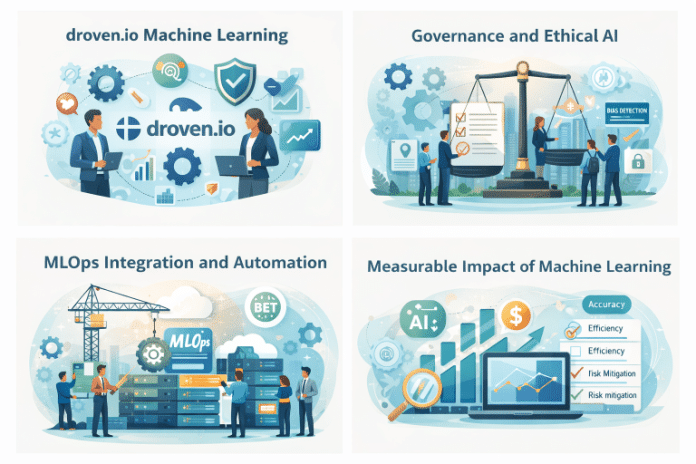
One of the most transformative movements in droven.io machine learning trends is the institutionalization of operational discipline through MLOps.
Machine learning without structured operations creates fragility. Models may perform well in testing but degrade in production. Deployment delays create friction between teams. Performance drift goes unnoticed.
MLOps integrates development, validation, deployment, and monitoring into a cohesive lifecycle. This ensures models are not only built effectively but maintained responsibly.
A structured MLOps environment typically includes:
- Continuous integration and deployment pipelines
- Automated validation before production release
- Real-time monitoring of performance and drift
- Version-controlled experiment tracking
These mechanisms reduce human error, increase reproducibility, and support collaboration between data scientists, engineers, and operations teams.
Organizations that treat MLOps as infrastructure—not an optional add-on—scale faster and with less operational risk.
The Rise of Responsible and Ethical AI
Ethics is no longer a peripheral discussion. Intelligent systems influence financial approvals, healthcare diagnostics, recruitment decisions, logistics optimization, and public service delivery. Errors or bias can generate measurable harm.
Within droven.io machine learning trends, responsible development has become a structural priority. Ethical design now includes proactive bias detection, secure data management, transparent decision logic, and clearly defined accountability.
This is not about public relations positioning. It is about operational resilience. Poorly governed models can expose organizations to regulatory penalties, reputational damage, and strategic instability.
Responsible AI enhances trust. Trust strengthens adoption. Adoption accelerates transformation.
Measuring Measurable Outcomes
Innovation narratives alone do not justify investment. Executive leadership increasingly demands quantifiable returns.
Machine learning initiatives must demonstrate impact through clear indicators such as prediction reliability, operational efficiency gains, cost optimization, revenue contribution, and risk mitigation improvement.
One of the defining aspects of droven.io machine learning trends is the shift from experimentation to performance accountability. Leaders want clarity on how intelligent systems reduce uncertainty and improve competitiveness.
For example, a predictive maintenance model in manufacturing may reduce downtime by measurable percentages. A fraud detection system may lower financial losses while increasing transaction speed. These are tangible outcomes—not theoretical possibilities.
Sustainable adoption depends on performance transparency.
Integration with Core Business Strategy
Machine learning cannot operate in isolation. Its value multiplies when aligned with long-term strategic objectives.
Organizations that succeed integrate intelligent systems into enterprise architecture planning, operational design, and customer experience strategy. They do not treat models as side projects.
This alignment includes:
- Linking model objectives to defined business KPIs
- Embedding analytics within decision-making workflows
- Ensuring cross-departmental collaboration
- Establishing leadership oversight
The broader perspective within droven.io machine learning trends emphasizes that technology is not the differentiator—strategic alignment is.
Addressing Common Misconceptions
Despite rapid progress, misconceptions persist.
One common belief is that more data automatically guarantees better results. In reality, data quality and relevance matter more than volume. Poorly structured datasets amplify bias and degrade performance.
Another misconception is that automation eliminates human involvement. In practice, oversight becomes more critical as systems scale. Governance frameworks must evolve alongside technical complexity.
A third misunderstanding is that machine learning guarantees immediate financial return. Implementation requires iterative refinement, cross-functional coordination, and disciplined evaluation.
The patterns observed in droven.io machine learning trends consistently show that organizations succeeding in AI adoption combine technical excellence with operational maturity.
Long-Term Transformation Through Iterative Scaling
Enterprise machine learning transformation follows a staged evolution:
- Exploration – Testing feasibility through controlled pilots.
- Operationalization – Integrating validated models into production workflows.
- Optimization – Refining performance through monitoring and iteration.
- Institutionalization – Embedding governance, automation, and strategic oversight.
Skipping stages creates instability. Sustainable progress requires disciplined iteration.
Transformation is not defined by how advanced a model appears. It is defined by how consistently it performs within real-world constraints.
Authority, Governance, and Risk Management
As machine learning systems influence critical decisions, governance frameworks become essential. Documentation standards, audit trails, and review processes reduce misuse risk and strengthen accountability.
Within droven.io machine learning trends, governance is viewed not as restriction but as an enabler of scale. Clear ownership structures, periodic evaluation, structured risk assessment, and transparent reporting build long-term resilience.
Organizations that neglect oversight may achieve short-term gains but face long-term instability.
Risk-aware implementation protects both innovation and reputation.
Why These Trends Matter in the Modern Context
Digital transformation is no longer optional. Global competition, operational complexity, and data proliferation require intelligent systems capable of adaptive analysis.
However, the real differentiator lies in responsible execution. Evidence across industries shows that structured deployment reduces failure rates, improves stakeholder trust, and enhances long-term return on investment.
Ethical alignment is equally important. Responsible system design protects individuals and institutions from unintended harm. It also strengthens investor and public confidence.
The strategic lens provided by droven.io machine learning trends highlights that sustainability not novelty defines success.
Frequently Asked Questions (FAQ)
1. What are droven.io machine learning trends?
Droven.io machine learning trends refer to the strategic developments shaping how organizations design, deploy, govern, and scale intelligent systems. They focus on operational discipline, measurable outcomes, ethical alignment, and long-term sustainability rather than experimental innovation alone.
2. Why is governance important in droven.io machine learning trends?
Governance ensures transparency, accountability, and risk control. Within droven.io machine learning trends, governance frameworks protect organizations from bias, performance drift, regulatory exposure, and reputational harm while enabling scalable and responsible AI growth.
3. How does MLOps support droven.io machine learning trends?
MLOps integrates development, deployment, and monitoring into a unified lifecycle. In droven.io machine learning trends, this operational discipline improves reproducibility, accelerates release cycles, reduces technical debt, and ensures models remain reliable in production environments.
4. Are droven.io machine learning trends only relevant for large enterprises?
No. While large organizations often lead adoption, droven.io machine learning trends apply to businesses of all sizes. Structured implementation, governance, and measurable evaluation are essential regardless of organizational scale or industry sector.
5. How can organizations measure success in droven.io machine learning trends?
Success is measured through performance metrics such as accuracy, efficiency gains, cost optimization, revenue contribution, and risk mitigation. Droven.io machine learning trends emphasize quantifiable outcomes over abstract innovation claims.
6. What role does ethics play in droven.io machine learning trends?
Ethics is central. Droven.io machine learning trends highlight bias mitigation, secure data handling, transparent decision logic, and accountability structures as essential components of sustainable and responsible AI deployment.
Conclusion
Machine learning is entering a phase of disciplined maturity. Innovation alone no longer defines leadership. Sustainable success requires governance, measurable performance, ethical alignment, operational scalability, and strategic integration.
The evolution captured within droven.io machine learning trends demonstrates that intelligent systems must be treated as enterprise infrastructure rather than isolated technical experiments. Organizations that embrace this mindset reduce risk, enhance trust, and generate lasting competitive advantage.
For decision-makers and professionals alike, the opportunity lies not in chasing novelty, but in building resilient, accountable, and performance-driven intelligent systems that create measurable long-term value.
