

Introduction
Understanding how hcs 411gits software built requires more than a surface-level overview. Clients, stakeholders, and technical decision-makers want clarity on the architecture, development approach, security standards, and scalability considerations behind the system.
Whether HCS 411GITS is designed for enterprise workflow management, institutional data processing, or integrated digital services, its foundation determines long-term performance and reliability. This article explains the structured process behind its development from planning and system architecture to deployment and optimization using industry-grade standards and best practices.
If you are evaluating the system, auditing its technical structure, or planning to build something similar, this guide provides a comprehensive and professional breakdown.
Strategic Planning and Requirement Engineering
Before any code was written, the development of HCS 411GITS software began with structured requirement analysis. This stage ensures the solution aligns with business goals and operational needs.
The process typically includes:
- Stakeholder interviews
- Functional and non-functional requirement documentation
- Workflow mapping
- Risk assessment
- Feasibility evaluation
Clear documentation helps reduce development ambiguity and ensures that performance, scalability, and compliance expectations are defined early.
For complex systems like HCS 411GITS, requirement engineering often follows globally recognized frameworks such as Agile or hybrid Agile-Waterfall models, depending on the organization’s compliance and governance standards.
System Architecture Design
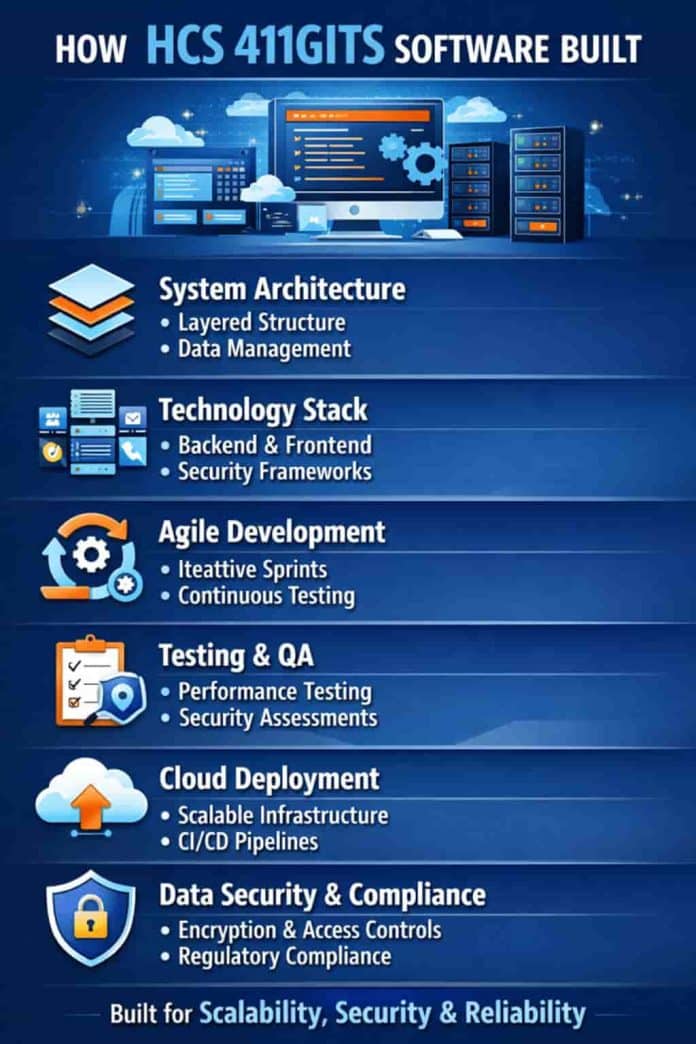
A strong software system depends on its architecture. HCS 411GITS was built using a layered architecture model, which separates the system into logical components.
1. Presentation Layer
This is the user interface where users interact with dashboards, reports, forms, and workflows. It is designed to be:
- Responsive across devices
- Accessible and user-friendly
- Optimized for performance
Modern front-end frameworks are commonly used to ensure dynamic rendering and interactive functionality.
2. Application Layer
The application layer contains business logic. This is where:
- Data validation occurs
- User permissions are processed
- Workflow automation runs
- Calculations and rule engines execute
Separating this layer ensures flexibility and easier updates without affecting user interfaces.
3. Data Layer
The database architecture supports structured data storage and secure retrieval. It typically includes:
- Relational database systems for transactional data
- Data indexing for faster querying
- Backup and disaster recovery mechanisms
- Encryption at rest and in transit
This layered architecture improves maintainability, security, and scalability.
Technology Stack Used in HCS 411GITS
To understand how hcs 411gits software built from a technical standpoint, examining its stack is essential.
While exact implementations may vary, enterprise-grade systems like this commonly use:
Backend Technologies
Robust backend frameworks handle server-side logic. These may include modern frameworks capable of supporting API development, microservices architecture, and secure authentication systems.
RESTful APIs are often implemented to enable integration with third-party systems, mobile applications, or institutional databases.
Frontend Technologies
The user interface is typically built with advanced JavaScript frameworks to enable:
- Dynamic content rendering
- Real-time updates
- Enhanced user experience
Responsive design ensures cross-device compatibility.
Database Systems
Structured data storage is managed through enterprise-grade database systems. These systems support:
- High transaction volumes
- Complex reporting queries
- Role-based data access
- Data integrity enforcement
Security Technologies
Security is embedded at every layer. This includes:
- Multi-factor authentication
- Role-based access control (RBAC)
- Secure API gateways
- SSL/TLS encryption
- Activity logging and audit trails
Security-first development is critical for compliance and long-term system integrity.
Development Methodology
HCS 411GITS software was built using an iterative and incremental development model. This approach ensures continuous improvement while minimizing risk.
Agile Framework Implementation
Agile methodology enables:
- Short development sprints
- Regular stakeholder feedback
- Continuous testing
- Rapid bug resolution
Each module is developed, tested, and validated before moving to the next cycle. This reduces large-scale failures and improves software stability.
Version Control and Collaboration
Modern development environments use distributed version control systems. These systems:
- Track code changes
- Prevent conflicts
- Enable collaborative development
- Support rollback in case of errors
This structured workflow ensures quality control across teams.
Testing and Quality Assurance
High-performing systems require rigorous testing. HCS 411GITS underwent multi-level testing processes to ensure reliability and performance.
Unit Testing
Each individual function or module is tested independently to confirm it performs as expected.
Integration Testing
Modules are tested together to verify proper communication between components.
Performance Testing
Stress testing ensures the system can handle:
- High user loads
- Large data volumes
- Concurrent transactions
Security Testing
Penetration testing and vulnerability scanning help identify weaknesses before deployment.
This layered testing strategy ensures production readiness.
Deployment and Infrastructure
Deployment is not simply uploading code to a server. HCS 411GITS software was built with deployment architecture that supports scalability and uptime.
Cloud-Based Infrastructure
Modern systems commonly use cloud platforms to provide:
- Horizontal scalability
- Automated backups
- Load balancing
- Global access
Cloud hosting improves system reliability and reduces hardware dependency.
Continuous Integration and Continuous Deployment (CI/CD)
Automated pipelines are often implemented to:
- Test code automatically
- Deploy updates seamlessly
- Minimize downtime
- Reduce human error
This approach ensures ongoing improvements without service disruption.
Scalability and Future-Proofing
A critical aspect of how hcs 411gits software built is its scalability design.
The system is structured to:
- Add new modules without major restructuring
- Integrate external APIs
- Handle increasing user demand
- Support international compliance requirements
Microservices or modular architectures make it easier to expand functionality as business needs evolve.
Data Protection and Compliance
Modern enterprise software must align with global data protection standards.
HCS 411GITS includes:
- Encrypted data storage
- Secure session management
- Role-based access control
- Data access logging
- Regular backup protocols
Compliance alignment with international data privacy regulations ensures trust and operational continuity.
User Experience and Accessibility
Technical performance alone is not enough. The system is designed with user-centric principles.
Key considerations include:
- Clear navigation structures
- Minimal learning curve
- Accessible design standards
- Multilingual adaptability
- Mobile responsiveness
A strong user experience reduces training time and improves adoption rates.
Maintenance and Support Structure
Long-term performance depends on structured maintenance.
HCS 411GITS software includes:
- Scheduled updates
- Security patches
- Performance monitoring
- Technical documentation
- Support escalation frameworks
Proactive monitoring helps prevent downtime and ensures operational continuity.
Frequently Asked Questions (FAQ)
How was HCS 411GITS software built?
HCS 411GITS software was built using a structured development lifecycle that includes requirement analysis, system architecture design, backend and frontend development, multi-level testing, and scalable cloud deployment.
What architecture does HCS 411GITS use?
It uses a layered architecture model that separates presentation, business logic, and data management to improve scalability, security, and maintainability.
Is HCS 411GITS scalable?
Yes. The system is designed with modular or microservices architecture, allowing it to handle increased users, data loads, and additional features without major restructuring.
What technologies support HCS 411GITS?
The software typically uses modern backend frameworks, API-driven integrations, secure database systems, cloud infrastructure, and CI/CD pipelines to ensure performance and reliability.
How secure is HCS 411GITS software?
Security is embedded throughout the system, including encrypted data storage, secure authentication mechanisms, role-based access control, and regular vulnerability testing.
Conclusion
Understanding how hcs 411gits software built reveals a carefully structured, enterprise-grade development process grounded in architectural discipline, security-first engineering, and scalable infrastructure design.
From requirement gathering and layered architecture to rigorous testing and cloud deployment, every stage reflects best practices in modern software engineering. The result is a secure, scalable, and maintainable system capable of supporting evolving business needs.
If you are evaluating HCS 411GITS or planning to build a similar platform, focusing on architecture, scalability, and security from the outset will determine long-term success. A professionally engineered foundation is not just a technical choice it is a strategic investment.
