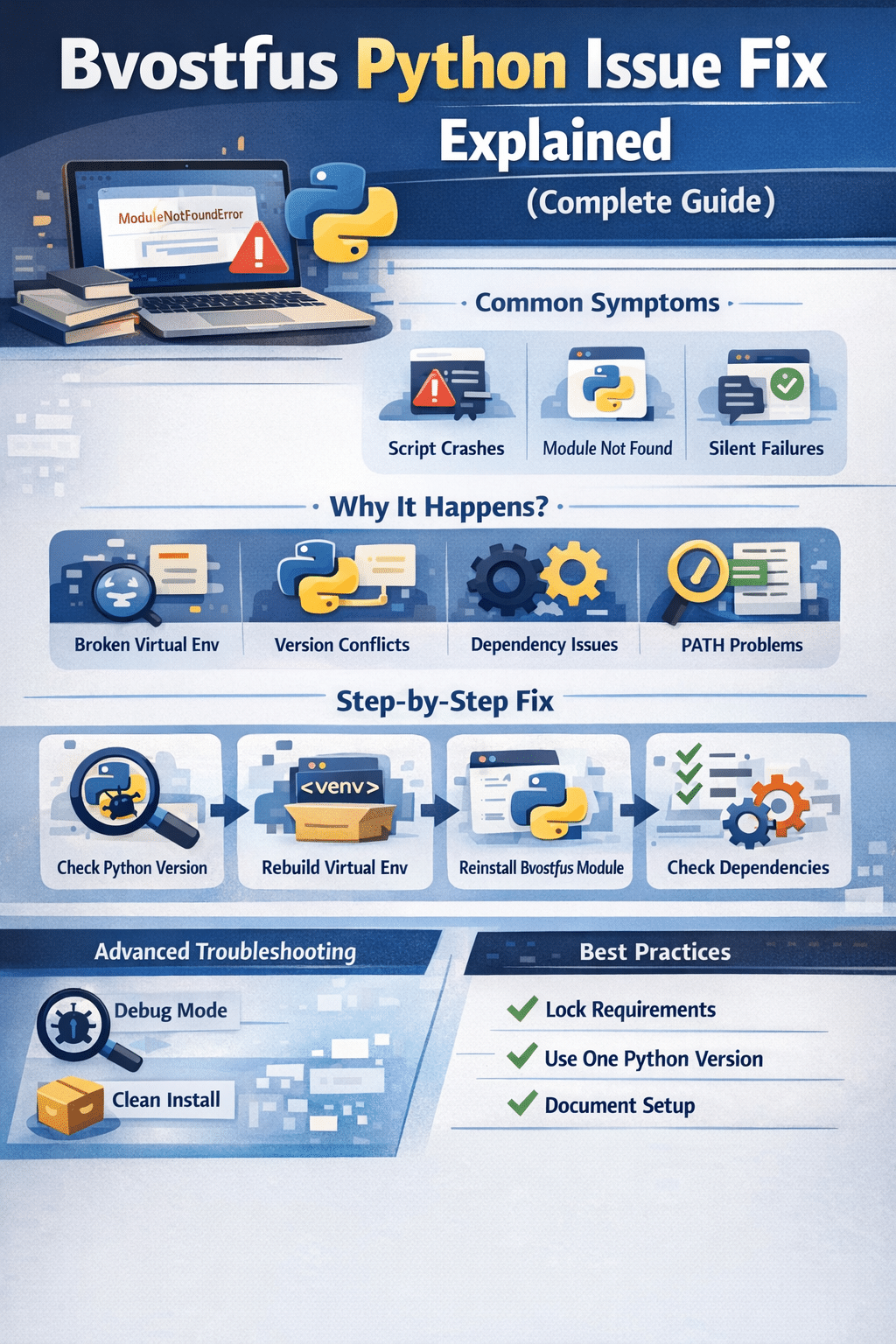

A Bvostfus Python issue can be unusually difficult to diagnose because the term appears across several websites, yet verifiable technical information about an official Bvostfus Python package remains limited.
Some pages describe Bvostfus as a Python package, development environment, automation framework or troubleshooting tool. However, the exact bvostfus endpoint in PyPI’s package-data service currently returns a 404 response. A GitHub repository search shows only one matching public repository, identified as HTML rather than a released Python package. The Bvostfus website itself describes its purpose as publishing Python guides, software tutorials and technology content.
This means a Bvostfus Python issue may not come from an established public library. It could instead involve a misspelled dependency, a private company package, a missing local module, AI-generated code, an incorrect Python interpreter or an unverified download.
This guide explains how to determine what Bvostfus refers to, diagnose the actual Python error and fix the underlying problem without installing unknown software.
The Bvostfus Python issue usually occurs because Python cannot find a module named bvostfus, the package name is incorrect, the required code is stored locally or privately, or pip installed a dependency into a different Python environment.
As of July 18, 2026, a public Python distribution named bvostfus cannot be confirmed through its exact PyPI package-data endpoint. Do not respond by downloading a random installer or blindly running:
pip install bvostfus
First verify the project name, original source, active Python interpreter, virtual environment and package index.
Key Takeaways
- The Bvostfus Python issue cannot currently be linked to an established public PyPI distribution under that exact name.
ModuleNotFoundErrordoes not automatically mean that a package with the same name should be installed.- A Python import name and pip distribution name can be different.
- The wrong interpreter, inactive virtual environment or incorrect IDE kernel commonly causes missing-module errors.
- The Bvostfus Python issue could theoretically involve a private or local package.
pip checkcan identify missing and incompatible installed dependencies.- Unknown installers and scripts should not be executed, and unverified
.whl,.zipor source-distribution files should not be installed or extracted. - A clean virtual environment is normally safer than changing the global Python installation.
- Private package indexes require extra care because poor configuration can create dependency-confusion risks.
- Reinstalling Python should be a last resort, not the first fix.
Bvostfus Python Issue: 60-Second Diagnostic
Before reinstalling Python, deleting project files or downloading anything, run these checks from the same terminal where the error appears.
First, identify the active Python interpreter and check whether it can locate a module named bvostfus:
python -c "import sys, importlib.util; s=importlib.util.find_spec('bvostfus'); print('Python:', sys.executable); print('Module:', s.origin if s else 'not found')"
Then run:
python -m pip show bvostfus
python -m pip config list
Interpret the results using this table:
| Result | What It Means | Recommended Next Step |
|---|---|---|
Module shows not found |
The active interpreter cannot locate an import named bvostfus |
Determine whether it should be an external dependency or local module |
| Module points to the project folder | Python found a local file or package | Inspect the project structure and import statement |
Module points to site-packages |
An installed distribution provides the module | Check its version, metadata and source |
pip show reports package not found |
No distribution with that exact name is installed in the active environment | Do not assume the same name should be installed |
| An unfamiliar index appears | Pip may be using a private mirror or custom repository | Confirm the approved index with the project owner |
| Python and pip paths differ | The dependency may be installed under another interpreter | Activate the correct environment and use python -m pip |
Python’s find_spec() function searches for a module specification and returns None when it cannot locate one. Python imports are resolved through its import system and module search paths.
What Is the Bvostfus Python Issue?
“Bvostfus Python issue” is not the name of a standard Python exception.
It is a search phrase that may describe any of the following situations:
ModuleNotFoundError: No module named 'bvostfus'- A failed
pip install bvostfuscommand - An import statement copied from an unverified tutorial
- A missing folder named
bvostfus - A private dependency not available on public PyPI
- Code generated by an AI assistant that references a nonexistent package
- A script downloaded from an unknown website
- A Python interpreter or virtual-environment mismatch
- An incompatible wheel or Python version
- A network, certificate or authentication failure
The full traceback matters more than the general search phrase. Python’s documentation explains that the final line identifies the exception type and describes what happened, while the preceding traceback shows the execution context and source lines involved.
Is Bvostfus Python a Real Package?
What the Current Evidence Shows
When investigating a Bvostfus Python issue, the available evidence does not currently confirm that a public package named bvostfus exists through the exact PyPI JSON endpoint, which returns a 404 response. That means no public project metadata was available from that endpoint when checked on July 18, 2026.
When checked on July 18, 2026, GitHub repository search returned one matching public repository, categorized as HTML rather than Python. The result is categorized as HTML, not Python, and does not demonstrate the normal characteristics of a maintained Python distribution, such as released package files, version tags or published package metadata.
The Bvostfus website describes itself as a source for Python guides, software tutorials, troubleshooting information and technology updates. This evidence matters when researching a Bvostfus Python issue because it supports the possibility that “Bvostfus” is primarily a publishing identity or website name rather than an official Python package.
What a Verifiable Public Python Project Normally Provides
A legitimate public Python project commonly includes several of the following:
- A PyPI project page
- Distribution metadata
- A documented installation command
- Version history
- Maintainer information
- Source code
- Releases or tags
- A software license
- Supported Python versions
- Dependency information
- Usage documentation
- Tests or issue tracking
The absence of one item does not automatically make software unsafe. However, when almost all identifying and reproducible information is missing, users should not treat unverified installation instructions as trustworthy.
Why Some Websites Describe Bvostfus as Software
Several third-party articles describe Bvostfus as a development tool, package manager, automation framework or integrated Python system. Those descriptions are not enough to establish that downloadable software exists.
Repeated online claims may come from:
- Rewritten content
- AI-generated articles
- Search-engine keyword targeting
- Confusion between a website and a software product
- A private project that was never publicly released
- A misspelling repeated across multiple pages
For any Bvostfus Python issue, do not accept a claim simply because several websites use similar wording. Verify the package through primary technical evidence.
This article separates confirmed Python behavior from unverified claims related to the Bvostfus Python issue.
The verification process includes:
- Checking the exact PyPI package-data endpoint
- Searching for matching public source repositories
- Reviewing available repository language and release information
- Examining the stated purpose of the Bvostfus website
- Comparing suggested fixes with official Python and pip documentation
- Avoiding unsupported claims about features, pricing, versions or system requirements
Package availability and ownership can change. A private package supplied by an employer, school, client or known developer may not appear on public PyPI. In that situation, follow the documentation provided by the project owner.
Why the Bvostfus Python Issue Happens
Several different problems can produce an error associated with Bvostfus.
1. No Public PyPI Distribution Could Be Verified Under That Name
Pip searches PyPI by default unless another index or source has been configured. It can also install from local directories, archives, version-control systems and alternative indexes.
When no matching distribution exists on the selected index, pip may display:
ERROR: Could not find a version that satisfies the requirement bvostfus
or:
ERROR: No matching distribution found for bvostfus
This does not mean that you should look for an unofficial installer. It means the requested distribution connected to the Bvostfus Python issue could not be found through the sources pip searched.
2. The Name Is Misspelled
A single incorrect character can point pip or Python to the wrong name.
Bvostfus could be:
- A typo
- A project codename
- A local folder
- An internal package
- A filename
- A documentation error
- An AI-generated dependency
- A misread word from an image or screenshot
Compare the term with the original:
- Repository
requirements.txtpyproject.toml- Assignment instructions
- Error traceback
- Developer documentation
- Package-lock or dependency file
Do not select a similarly named package based only on search results.
3. The Distribution Name and Import Name Are Different
The name used with pip does not always match the name used in Python code, which is an important consideration when diagnosing a Bvostfus Python issue.
For example, the distribution package Pillow provides the import package PIL. The Python Packaging User Guide specifically warns that users cannot safely assume import foo means they should run pip install foo, because the matching PyPI name could refer to unintended or malicious software.
Therefore, this code:
import bvostfus
does not prove that this command is correct:
pip install bvostfus
The legitimate project documentation must identify the actual distribution name.
4. Pip Installed the Dependency Into Another Python Environment
A computer may contain several Python installations:
- Python installed from Python.org
- Microsoft Store Python
- Anaconda or Miniconda
- A project virtual environment
- A system-managed Python
- A WSL Python installation
- An IDE-managed interpreter
- A Docker container
- A Jupyter kernel
Running pip install through one interpreter and executing code through another can produce ModuleNotFoundError, which is a common cause of the Bvostfus Python Issue.
Using:
python -m pip
associates pip with the Python interpreter invoked by the command. Pip’s official examples use python -m pip on Unix and macOS and py -m pip on Windows.
5. The Virtual Environment Is Not Active
Virtual environments isolate project-specific Python interpreters and dependencies. This lets different projects use different versions without modifying one global installation.
When the correct environment is inactive, the terminal or IDE may use another interpreter that cannot access the project’s dependencies, potentially causing the Bvostfus Python Issue.
6. Bvostfus Is a Local Project Module
The project may expect a local folder rather than a downloadable package, which is another possible explanation for the Bvostfus Python Issue.
For example:
project/
├── main.py
└── bvostfus/
    ├── __init__.py
    └── helpers.py
This import:
from bvostfus.helpers import run_task
will fail if the folder is missing, renamed or located outside Python’s module search path.
Python searches directories in sys.path when resolving imports.
8. Dependencies Are Missing or Incompatible
A project may import successfully but fail later because one of its supporting libraries is missing or has the wrong version. This can be another cause of the Bvostfus Python Issue.
The command:
python -m pip check
verifies whether installed packages have compatible dependencies. A healthy environment reports:
No broken requirements found.
When a dependency is missing or incompatible, the command identifies the affected package and requirement.
9. The Name Came From AI-Generated Code
AI coding assistants can produce plausible package names that do not correspond to real public projects. In some cases, the Bvostfus Python Issue may begin with an AI-generated import or dependency that was never verified.
Before accepting an unfamiliar dependency, confirm:
- Its official project page
- Its public or private repository
- Its maintainer
- Its distribution name
- Its import name
- Its documentation
- Its release history
- Its software license
Do not install the first package that resembles an AI-generated import.
10. The Available Release Is Incompatible With Your System
For verified packages, “No matching distribution found” can also mean no available release supports the current environment. This type of compatibility problem may also produce the Bvostfus Python Issue.
Possible incompatibilities include:
- Unsupported Python version
- Wrong operating system
- Wrong processor architecture
- Incompatible Python implementation
- Incompatible ABI
- Only a pre-release is available
- Pip is using the wrong index
- A proxy or certificate policy blocks access
Run:
python -m pip debug --verbose
This displays debugging information related to the interpreter, platform, Python version, implementation and compatible wheel tags. Pip warns that the command is intended for debugging and that its output may change.
Also inspect the active configuration:
python -m pip config debug
Look for unexpected values involving:
index-url
extra-index-url
find-links
trusted-host
proxy
The pip config command can list active values and show the configuration files where they are defined.
Common Bvostfus Error Messages
The following table explains errors commonly associated with the Bvostfus Python Issue, their likely meanings and the safest first actions.
| Error or Symptom | Likely Meaning | First Action |
|---|---|---|
ModuleNotFoundError: No module named 'bvostfus' |
The active interpreter cannot locate that import, which may cause the Bvostfus Python Issue | Verify the module name, interpreter and project files |
Could not find a version that satisfies the requirement bvostfus |
No compatible distribution was found in the selected sources | Confirm the exact distribution and package index |
No matching distribution found for bvostfus |
Pip found no acceptable release | Check the name, index and platform compatibility |
ImportError: cannot import name... |
The module exists, but the requested object does not | Check the API, version and imported file |
AttributeError |
The loaded module does not provide the expected attribute | Inspect the import path and documentation |
Permission denied |
Python cannot write to or access the destination | Use a virtual environment and inspect permissions |
Dependency conflict |
Installed package versions are incompatible | Run python -m pip check |
| Works in terminal but not in IDE | The IDE uses another interpreter | Select the correct project interpreter |
Works globally but not in .venv |
The package is absent from the project environment | Install only verified requirements inside .venv |
| Unknown installer crashes | The file may not be legitimate Python software | Stop execution and run an approved security scan |
401 Unauthorized |
Private repository credentials are missing or invalid | Request approved access |
CERTIFICATE_VERIFY_FAILED |
Certificate trust or proxy configuration failed | Check the network and certificate policy |
Bvostfus Python Network, SSL and Authentication Errors
Some installation problems connected to the Bvostfus Python Issue come from the network or package repository rather than the Python code.
| Error | Likely Cause | Recommended Check |
|---|---|---|
CERTIFICATE_VERIFY_FAILED |
Certificate trust issue, proxy interception or incorrect system time | Check the network, certificate policy and clock |
Read timed out |
Slow connection, proxy failure or unavailable repository | Retry the verified source and inspect proxy settings |
401 Unauthorized |
Missing or expired private-index credentials | Request valid credentials |
403 Forbidden |
The account does not have access | Confirm repository permissions |
Temporary failure in name resolution |
DNS or network connectivity problem | Test connectivity without disabling security controls |
| Package opens in a browser but pip cannot find it | Different index, interpreter or pip configuration may be contributing to the Bvostfus Python Issue | Run python -m pip config debug |
| Connection works outside the company network only | VPN, firewall or proxy rules may apply | Contact the repository administrator |
Do not permanently disable certificate verification or add an unknown website as a trusted host merely to bypass an error.
On a workplace or school device, contact the organization’s IT team before changing certificate, proxy or repository settings.
How to Diagnose the Bvostfus Python Issue
Step 1: Copy the Complete Error
Save the complete traceback, not only the final sentence.
Record:
- The exact command
- Full traceback
- Operating system
- Python version
- Pip version
- Project source
- Current working directory
- IDE or notebook being used
- Virtual-environment name
- Relevant dependency files
The last traceback line usually identifies the exception, while the preceding lines show where the error occurred.
Step 2: Check the Python Version
Run:
python --version
Windows users can also try:
py --version
If neither command works, Python may not be installed correctly or may not be available through the current shell’s PATH.
Step 3: Identify the Active Interpreter
Run:
python -c "import sys; print(sys.executable)"
Possible output:
C:\Users\Name\Project\.venv\Scripts\python.exe
or:
/usr/bin/python3
or:
/Users/name/project/.venv/bin/python
This path identifies the interpreter that will execute the project.
Step 4: Check Which Pip Is Being Used
Checking which pip installation is active is essential when diagnosing the Bvostfus Python Issue.
Run:
python -m pip --version
Windows users may also use:
py -m pip --version
Compare the pip location with the path printed by sys.executable. Both should belong to the intended environment.
Step 5: Check Whether a Distribution Is Installed
Run:
python -m pip show bvostfus
If the command reports that the package was not found, no distribution with that exact name is installed in the active environment.
That result does not prove that you should install it. It only describes the current environment.
Step 6: Find Exactly What Python Would Import
Run:
python -c "import importlib.util; s=importlib.util.find_spec('bvostfus'); print(s.origin if s else 'Module not found')"
Possible results:
C:\Project\bvostfus.py
C:\Project\.venv\Lib\site-packages\bvostfus\__init__.py
Module not found
A project path usually indicates a local file or folder.
A site-packages path usually indicates an installed distribution.
An unexpected path may reveal file shadowing or the wrong interpreter.
Step 7: Inspect Python’s Module Search Path
Run:
python -c "import sys; print('\n'.join(sys.path))"
Python searches these locations when resolving modules. A file in the current project may be found before the intended installed package.
Step 8: Map an Import Name to Its Distribution
On supported Python versions, run:
python -c "from importlib.metadata import packages_distributions; print(packages_distributions().get('bvostfus'))"
The packages_distributions() function maps top-level import names to the installed distributions that provide them. It may be unreliable for some editable installations, so treat the result as supporting evidence rather than final proof.
Step 9: Inspect Available Index Versions
Run:
python -m pip index versions bvostfus
This checks configured package indexes for versions under that exact distribution name and may help identify the cause of the Bvostfus Python Issue.
A failed result may indicate:
- No public or private distribution exists
- The name is incorrect
- Authentication is required
- The selected index is wrong
- No compatible version is available
Step 10: Search the Project Files
Search for the word bvostfus.
Windows PowerShell
Get-ChildItem -Recurse -File | Select-String "bvostfus"
macOS or Linux
grep -Rni "bvostfus" .
Review matches inside:
requirements.txtpyproject.tomlsetup.py- Python source files
- Notebook cells
- Docker files
- CI configuration
- IDE settings
- Documentation
This helps determine whether Bvostfus is intended to be an external package, local module, variable, command or project name.
How to Fix the Bvostfus Python Issue
Because Bvostfus remains unverified as a public package, the goal is not to force-install it. The goal is to identify what the project actually requires.
Fix 1: Verify the Original Source
Return to the source where the code or installation command appeared.
A trustworthy project should identify:
- Repository owner
- Distribution name
- Import name
- Supported Python versions
- Installation method
- Dependency file
- License
- Documentation
- Release version
- Issue tracker
When those details are missing, contact the author or use a better-documented source.
Fix 2: Confirm the Intended Name
Compare bvostfus character by character with the original project files.
Check:
- Capitalization
- Hyphens
- Underscores
- Similar-looking letters
- Singular or plural wording
- Internal namespace prefixes
Do not install a similar package as a guess.
Fix 3: Use the Correct Interpreter
Using the correct interpreter is essential when resolving the Bvostfus Python Issue.
Run these commands in the same terminal:
python -c "import sys; print(sys.executable)"
python -m pip --version
python -m pip list
The paths should belong to the same environment.
Inside an IDE, select the same interpreter before rerunning the project.
Fix 4: Check the IDE or Jupyter Kernel
A package may work in a terminal but fail in Visual Studio Code, PyCharm or Jupyter when the application uses another interpreter.
Inside the failing program or notebook, run:
import sys
print(sys.executable)
Compare it with:
python -c "import sys; print(sys.executable)"
Visual Studio Code
Open the Command Palette and select:
Python: Select Interpreter
Choose the interpreter inside the project’s .venv directory.
PyCharm
Open:
Project Settings > Python Interpreter
Confirm that the intended environment is selected.
Jupyter or IPython
Run:
%pip show bvostfus
IPython documents %pip as running pip within the current kernel. This is more reliable for kernel-specific inspection than a separate shell pip command.
Do not run %pip install bvostfus unless the project owner confirms the correct distribution.
Fix 5: Create a Clean Virtual Environment
Creating a clean virtual environment can help isolate the Bvostfus Python Issue from conflicting global packages or incorrect interpreter settings.
Create a project environment:
python -m venv .venv
Activate it on Windows PowerShell:
.\.venv\Scripts\Activate.ps1
Activate it in Windows Command Prompt:
.venv\Scripts\activate.bat
Activate it on macOS or Linux:
source .venv/bin/activate
Python’s official venv documentation lists separate activation commands for Windows PowerShell, Command Prompt and POSIX shells. It also explains that virtual environments isolate packages from the base Python installation.
Verify the interpreter:
python -c "import sys; print(sys.executable)"
Do not install Bvostfus unless a verified source provides legitimate instructions.
Fix 6: Install Only Verified Project Requirements
When a legitimate project includes requirements.txt, inspect it before installation.
Then run:
python -m pip install -r requirements.txt
Pip supports requirements files as a method for defining an environment. It can also install from verified project directories, archives and version-control sources.
For projects using pyproject.toml, follow their documented installation process.
Fix 7: Preview the Installation Plan
After verifying the project and dependencies, preview what pip intends to install. This can help identify whether the Bvostfus Python Issue is connected to an unexpected package version, download source or dependency change.
Run:
python -m pip install --dry-run --ignore-installed --report install-plan.json -r requirements.txt
Pip documents that --dry-run, --ignore-installed and --report can resolve requirements and generate a report without completing the installation.
Review:
- Selected versions
- Download sources
- Direct dependencies
- Transitive dependencies
- Packages that would be replaced
A dry run is not a security sandbox. Do not use it as permission to investigate obviously suspicious code on a sensitive computer.
Fix 8: Repair a Missing Local Module
If Bvostfus is supposed to be part of the project, a missing local module may be responsible for the Bvostfus Python Issue.
Confirm that:
- The folder exists
- The spelling matches the import
- The repository was fully downloaded
- Git submodules were included
- You opened the correct project root
- Required files were not excluded
- The package structure is valid
For example:
from bvostfus.helpers import run_task
requires a corresponding module structure such as:
bvostfus/
├── __init__.py
└── helpers.py
Request missing code from the verified project owner rather than downloading an unrelated file.
Fix 9: Remove File-Name Conflicts
Check the project for files named:
bvostfus.py
python.py
pip.py
json.py
typing.py
requests.py
A conflicting local filename can cause Python to import the wrong module and trigger the Bvostfus Python Issue.
Rename a conflicting file only after confirming it is not intentionally part of the application.
Then remove stale __pycache__ directories and restart the interpreter or IDE.
Fix 10: Check Installed Dependencies
Run:
python -m pip check
When the environment is healthy, pip reports:
No broken requirements found.
Resolve only the dependencies reported as missing or incompatible. Do not upgrade every installed package at once.
Fix 11: Rebuild the Virtual Environment
When the environment is badly mixed, recreating it may be safer than repeatedly forcing installations.
Save the current package list for review:
python -m pip freeze > installed-packages.txt
Deactivate the environment:
deactivate
Delete only the project’s .venv directory.
Then recreate it:
python -m venv .venv
Install dependencies from the verified project file.
Python describes virtual environments as isolated and disposable and recommends recreating them rather than moving or copying them between locations.
Fix 12: Ask the Project Owner
When Bvostfus appears in workplace, school or client code, ask:
- Is Bvostfus an internal package?
- What is the exact distribution name?
- What import name should be used?
- Which package index hosts it?
- Which version is required?
- Is authentication required?
- Is it bundled with another repository?
- Which Python version is supported?
- Is a VPN required?
- Where is the official documentation?
A private dependency may not appear on public PyPI, but its owner should provide reproducible installation instructions.
Private Package Indexes and Dependency Confusion
Bvostfus could theoretically be hosted on a private repository.
Inspect pip’s configuration:
python -m pip config debug
python -m pip config list
Ask whether the package is supplied through:
- A private Python index
- An internal artifact repository
- A Git repository
- A local network share
- A company wheel directory
- A development container
- A bundled project dependency
Warning About --extra-index-url
Do not add an unknown repository merely to make an error disappear.
Pip warns that using --extra-index-url for private packages can create a dependency-confusion vulnerability. Because pip searches the configured locations and selects a matching candidate, an attacker may publish a public package using the same name as a private dependency.
Follow the organization’s approved installation process. It may use:
- A dedicated
--index-url - An authenticated repository manager
- A private mirror
- A company VPN
- A locked dependency file
- A controlled container image
Never expose repository credentials in public code, screenshots, articles or shared configuration files.
Windows-Specific Troubleshooting
Windows may have several Python launch methods.
Run:
python --version
py --version
where python
where pip
py -0p
Then compare:
python -c "import sys; print(sys.executable)"
python -m pip --version
Create a clean environment:
py -m venv .venv
Activate it in PowerShell:
.\.venv\Scripts\Activate.ps1
Activate it in Command Prompt:
.venv\Scripts\activate.bat
Check the environment:
python -c "import sys; print(sys.executable)"
python -m pip check
Python notes that Windows PowerShell may require an appropriate execution policy before Activate.ps1 can run. Do not permanently weaken a managed computer’s security settings without authorization.
Avoid running every command as administrator. A normal project virtual environment usually prevents the need to modify protected system directories.
macOS and Linux Troubleshooting
Some systems use python3 rather than python.
Check:
python3 --version
which python3
python3 -m pip --version
Create an environment:
python3 -m venv .venv
Activate it:
source .venv/bin/activate
Verify:
python -c "import sys; print(sys.executable)"
python -m pip check
Avoid using:
sudo pip install bvostfus
or routine global sudo pip install commands. Mixing pip-managed files with operating-system-managed Python packages can cause permission and dependency problems.
What to Do After Downloading an Unknown Bvostfus File
Take extra precautions when you have already downloaded a file advertised as Bvostfus software.
Do Not Open Unknown Files Immediately
Avoid launching unverified:
.exe.msi.bat.cmd.ps1.sh.py.zip.tar.gz.whl
Pip’s secure-install documentation notes that installing distributions can involve executing arbitrary code.
If You Already Executed the File
Take these steps when suspicious activity appears:
- Disconnect the device from the internet.
- Stop entering passwords or payment information.
- Run a full scan using approved security software.
- Review recently installed applications.
- Check startup entries and scheduled tasks.
- Review new browser extensions.
- Record the filename and source page.
- Change important passwords from a clean device if compromise is suspected.
- Contact IT or a security professional for a business device.
Preserve Useful Evidence
Record:
- File name
- File size
- Download source
- Download time
- Commands executed
- Security warnings
- New processes or applications
- Changes noticed afterward
Do not upload confidential company files to public scanning services without permission.
What Not to Do
Avoid these risky responses:
- Do not download a “Bvostfus installer” from a random website.
- Do not assume
import bvostfusproves thatpip install bvostfusis correct. - Do not disable antivirus protection to complete an installation.
- Do not permanently bypass certificate verification.
- Do not add an unknown
trusted-host. - Do not use administrator or root access without a clear reason.
- Do not use
--break-system-packagessimply to bypass an error. - Do not install a similarly named package as a guess.
- Do not globally upgrade every dependency.
- Do not delete the system Python installation.
- Do not remove project files without a backup.
- Do not trust AI-generated dependency names without verification.
- Do not publish private repository credentials.
- Do not copy a virtual environment to another machine and expect it to remain portable.
Secure Installation Options for Verified Projects
Use these controls only after confirming that the project is legitimate.
Hash-Checked Requirements
Pip supports hash-checking mode:
python -m pip install --require-hashes -r requirements.txt
In this mode, requirements must be pinned and hashes must be supplied for direct and indirect dependencies. Pip documents hash checking as protection against remote tampering and network problems.
Reject Source Distributions
An organization may choose to accept only binary wheels:
python -m pip install --only-binary :all: -r requirements.txt
Pip lists --only-binary :all: as an additional secure-install restriction. It does not prove that a wheel is trustworthy, but it prevents fallback to source distributions.
Bvostfus Python Issue Troubleshooting Table
| Problem | Safe Diagnostic Command | Recommended Response |
|---|---|---|
| Package not found | python -m pip index versions bvostfus |
Verify the exact distribution name and index |
| Module cannot be imported | python -c "import importlib.util; print(importlib.util.find_spec('bvostfus'))" |
Determine whether the module is local, external or misspelled |
| Unknown installation status | python -m pip show bvostfus |
Confirm what is installed in the active environment |
| Wrong interpreter | python -c "import sys; print(sys.executable)" |
Select the correct project interpreter |
| Pip mismatch | python -m pip --version |
Use pip through the intended interpreter |
| Broken dependencies | python -m pip check |
Resolve only reported conflicts |
| Wrong virtual environment | Inspect the prompt and interpreter path | Activate or recreate the correct environment |
| Missing local module | Search project files for bvostfus |
Restore the folder from the project owner |
| File shadowing | Inspect find_spec() output |
Rename the conflicting local file |
| IDE-only failure | Print sys.executable inside the IDE |
Match the IDE interpreter to the terminal |
| Jupyter-only failure | Run %pip show bvostfus |
Inspect the active notebook kernel |
| Private package unavailable | python -m pip config debug |
Request the approved index and credentials |
| Incompatible wheel | python -m pip debug --verbose |
Check Python, OS, architecture and ABI |
| SSL error | Review certificate and proxy settings | Contact IT rather than disabling verification |
| Authentication failure | Check repository access | Request valid credentials |
| Suspicious download | Review the source and run an approved scan | Do not execute the file |
| AI-generated dependency | Search primary package sources | Ask the code author for a verified replacement |
How to Prevent Similar Python Problems
Use One Virtual Environment Per Project
Separate environments reduce version conflicts and make dependencies easier to reproduce.
Python recommends virtual environments when different applications require different package versions.
Keep a Verified Dependency File
Maintain dependencies in:
requirements.txtpyproject.toml- An approved lock file
- A company-controlled package manifest
Record exact or compatible versions according to the project’s maintenance policy.
Use python -m pip
Prefer:
python -m pip install verified-package
over:
pip install verified-package
This reduces ambiguity about which Python interpreter pip belongs to.
Verify Packages Before Installation
Check:
- PyPI project information
- Source repository
- Maintainer identity
- Release history
- License
- Supported Python versions
- Documentation
- Issue activity
- Dependency list
- Download origin
A polished website is not proof that software is genuine.
Read the Exact Traceback
Search for the final exception type and a distinctive traceback line.
Useful:
ModuleNotFoundError: No module named 'bvostfus'
Less useful:
Python is not working
Test Unknown Code Away From Sensitive Data
When evaluation is necessary, use an approved:
- Disposable virtual machine
- Development container
- Sandbox
- Non-sensitive test device
Do not test unknown scripts on a computer containing customer records, company credentials, private keys or cryptocurrency wallets.
Frequently Asked Questions
What is the Bvostfus Python issue?
The Bvostfus Python issue is an informal search phrase rather than a standard Python exception. It commonly refers to a missing import, failed pip installation, incorrect dependency name, private package, local module or interpreter mismatch.
Is Bvostfus an official Python package?
A public package under the exact name bvostfus could not be confirmed through its PyPI package-data endpoint as of July 18, 2026. The endpoint returned 404 when checked.
Why does pip install bvostfus fail?
The command may fail because no matching public distribution exists, the name is wrong, the package is private, pip is using another index or no available release supports the active Python environment.
How do I fix No module named 'bvostfus'?
Check the complete traceback, print sys.executable, inspect find_spec('bvostfus'), verify the project files and determine whether Bvostfus is an external dependency or local module. Do not install an unverified package automatically.
Can the pip name be different from the import name?
Yes. Distribution names and import names do not have to match. PyPA uses Pillow and PIL as a well-known example and warns against blindly installing a distribution based only on an import statement.
Could Bvostfus be a private package?
Yes. A company, school or developer may host an internal package outside public PyPI. The owner should provide the repository, version, credentials and installation instructions.
How do I check whether Python can find Bvostfus?
Run:
python -c "import importlib.util; print(importlib.util.find_spec('bvostfus'))"
A None result means the active interpreter could not locate the module.
How do I check for dependency conflicts?
Activate the project environment and run:
python -m pip check
The command reports missing or incompatible installed dependencies.
Will upgrading pip fix the problem?
It may solve some packaging compatibility issues, but it cannot create a nonexistent package, correct a misspelled name or restore a missing local module.
Should I reinstall Python?
Usually not. First check the interpreter, virtual environment, import path, IDE kernel, dependency files and private-index configuration. Reinstallation should be considered only after the real cause has been identified.
Is it safe to download Bvostfus from another website?
Not unless the source provides verifiable developer information, package metadata, source code, documentation and a legitimate release history.
What should I do if an unknown Bvostfus installer was already executed?
Disconnect the device if suspicious activity appears, run an approved security scan, record the file source and contact an IT or security professional when sensitive information may be affected.
Final Verdict
The safest conclusion is that the Bvostfus Python issue is not currently tied to a verifiable public Python distribution under that exact name.
The error is more likely to involve:
- An incorrect or invented package name
- A missing local module
- A private dependency
- The wrong Python interpreter
- An inactive virtual environment
- An IDE or notebook kernel mismatch
- An incompatible release
- An unverified download
Do not treat Bvostfus as established software merely because several websites describe it that way.
Use this repair sequence:
- Save the complete traceback.
- Confirm the original project source.
- Verify the distribution and import names.
- Print the active Python interpreter.
- Check what
find_spec()locates. - Inspect the pip configuration.
- Activate or recreate the virtual environment.
- Review verified dependency files.
- Run
python -m pip check. - Avoid unknown installers and forced installation commands.
This approach addresses the actual Python configuration or project problem without exposing the computer to unnecessary and potentially unsafe software.