

Introduction
Organizations across industries are under pressure to modernize how they operate, deliver value, and compete. Many initiatives fail because they treat transformation as a series of disconnected technology projects rather than a coordinated shift in how the organization works.
This is where digital infusing aggr8tech becomes relevant. The concept focuses on embedding digital capability into everyday processes, decisions, and culture so that technology strengthens the organization’s core rather than sitting on the edges.
Leaders often ask whether transformation is about tools, data, or automation. In practice, it is about alignment between strategy, operations, and people. A structured approach creates resilience, improves execution quality, and makes change sustainable.
This guide provides a practical, executive-level perspective on how to apply digital infusing aggr8tech as a long-term operating model rather than a short-term program.
Understanding Digital Infusing Aggr8tech as an Operating Model
Digital infusing aggr8tech is not a single platform or product. It is a way of designing how digital capability is absorbed into the organization’s daily work. Instead of creating isolated digital teams, it integrates digital thinking into leadership decisions, operational workflows, and performance management.
The approach assumes that technology only creates value when it reshapes how people work. Tools alone do not change outcomes. Outcomes change when processes, incentives, and accountability are redesigned to use digital capability effectively.
This operating model works across different organizational sizes and maturity levels because it focuses on principles rather than specific tools. The goal is to ensure that digital capability becomes a native part of how the organization functions.
Core Principles That Make the Model Work
Digital infusing aggr8tech is built on three practical principles that guide execution.
First, strategy must lead technology choices. Digital investment is prioritized based on business outcomes rather than trends. This prevents scattered initiatives that drain resources without creating durable value.
Second, integration matters more than speed. Rapid deployment without process integration often creates operational friction. Sustainable results come from embedding new capability into workflows, governance, and performance metrics.
Third, people enable transformation. Skills development, leadership behavior, and cultural reinforcement are treated as core transformation assets rather than support activities.
How Digital Infusing Aggr8tech Is Designed to Function
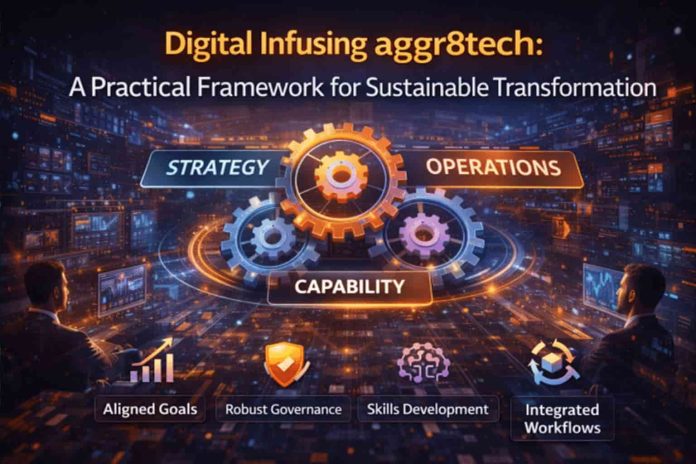
The methodology behind digital infusing aggr8tech treats transformation as a system redesign. It aligns strategy, operations, and capability development into a single execution framework.
Strategic Alignment Layer
At the strategic layer, leadership defines where digital capability creates the greatest leverage. This involves identifying high-friction processes, decision bottlenecks, and areas where data quality limits performance.
Clarity at this layer prevents technology from becoming an end in itself. Investment decisions are tied to measurable outcomes such as cycle-time reduction, service quality improvement, or risk reduction.
Operational Integration Layer
At the operational layer, digital capability is infused into existing workflows rather than layered on top of them. This requires redesigning how teams work, how information flows, and how accountability is structured.
The objective is not to digitize current inefficiencies but to remove structural friction. When workflows are re-architected around digital capability, productivity gains become durable rather than temporary.
Capability and Governance Layer
At the capability layer, digital infusing aggr8tech treats skills development and governance as core enablers. Teams are equipped to use digital tools intelligently rather than passively. Governance structures ensure standards, security, and performance discipline without slowing execution.
This layer is where many organizations fail by underinvesting. Without capability building, digital tools become underutilized assets.
Who Digital Infusing Aggr8tech Is Designed For
The model is relevant for leadership teams responsible for long-term performance, not just technology departments. It serves organizations facing structural complexity, rapid market change, or increasing operational risk.
Executive leadership benefits from a clearer line of sight between digital investment and strategic outcomes. Operational leaders gain more reliable execution and fewer fragmented initiatives. Teams benefit from workflows that reduce friction rather than increase it.
Digital infusing aggr8tech is particularly valuable for organizations that have invested heavily in technology but struggle to see consistent performance improvements. It provides a way to translate capability into results.
Measurable Benefits and Outcomes
When applied correctly, digital infusing aggr8tech produces measurable improvements in operational performance, decision quality, and organizational resilience.
Organizations typically observe sustained productivity gains because digital capability is embedded into daily workflows rather than treated as a separate layer. Decision-making improves as data becomes operationally relevant instead of being locked in reporting silos.
Risk exposure is reduced because governance is designed into digital workflows. Over time, organizations experience lower transformation fatigue because change becomes part of normal operations rather than episodic disruption.
How This Approach Differs From General Digital Programs
Traditional digital programs often focus on deploying tools, launching platforms, or modernizing infrastructure. While necessary, these actions do not guarantee value creation.
Digital infusing aggr8tech differs by treating transformation as a structural redesign of how the organization functions. Technology becomes a means to operational change rather than the primary objective.
This difference matters because many digital failures stem from misalignment between tools and operating models. When digital capability is infused into workflows, incentives, and governance, outcomes become more predictable and sustainable.
Real-World Application Scenarios
In operational environments with high coordination costs, digital infusing aggr8tech improves execution consistency by aligning workflows around shared data and standardized processes. Teams spend less time reconciling information and more time acting on it.
In service-driven organizations, the model improves service quality by embedding digital insight into frontline decision-making. Staff gain access to timely information that supports better judgment without adding administrative burden.
In complex organizations, digital infusing aggr8tech helps leadership move from reactive decision-making to proactive management. Signals from operations become visible earlier, allowing intervention before issues escalate.
Common Challenges and How to Address Them
One common challenge is treating digital infusing aggr8tech as a technology rollout rather than an operating model shift. This leads to fragmented adoption and weak outcomes.
Another challenge is cultural resistance. Teams may perceive digital infusion as added complexity rather than support. This risk is mitigated by redesigning workflows so that digital capability reduces friction rather than creating new tasks.
Leadership inconsistency also undermines transformation. When executives do not model digital behaviors or align incentives, digital infusing aggr8tech becomes symbolic rather than functional.
Strategic and Organizational Impact
Over time, digital infusing aggr8tech reshapes how organizations learn and adapt. The operating model becomes more responsive to change because digital capability is embedded into feedback loops.
Strategically, this improves organizational agility. Leaders gain faster insight into performance drivers and can adjust direction with less disruption. Operationally, teams experience fewer rework cycles because processes are designed for continuous improvement.
This structural impact differentiates sustainable transformation from one-off modernization efforts.
Long-Term Transformation as a Managed Process
Digital infusing aggr8tech is not a one-time initiative. It is a managed evolution of how the organization operates.
Successful organizations treat transformation as an ongoing discipline. They review workflows, governance, and capability development regularly to ensure alignment with strategic priorities. This creates compounding returns on digital investment rather than diminishing returns.
Authority and Trust: Why This Model Matters Now
Modern organizations operate in environments characterized by rapid change, information overload, and increasing risk exposure. Digital infusing aggr8tech matters because it provides a disciplined way to translate digital capability into operational reliability.
Evidence from transformation programs consistently shows that fragmented digital initiatives fail to produce durable value. An integrated operating model reduces execution risk by aligning incentives, governance, and workflows.
Ethically, this approach also reduces harm by minimizing uncontrolled experimentation and unmanaged data exposure. Risk management is designed into processes rather than added after failures occur.
From a long-term perspective, digital infusing aggr8tech improves return on digital investment by creating compounding operational benefits rather than one-off efficiency gains. This sustainability perspective strengthens both organizational resilience and stakeholder trust.
Frequently Asked Questions
What is digital infusing aggr8tech in simple terms?
Digital infusing aggr8tech is a structured way to embed digital capability into everyday operations rather than treating technology as a separate project. It aligns strategy, workflows, and skills so digital tools improve real outcomes, not just technical maturity.
How does digital infusing aggr8tech improve organizational performance?
Digital infusing aggr8tech improves performance by integrating digital capability into decision-making and workflows. This reduces operational friction, improves data quality in daily work, and aligns incentives with digital outcomes, leading to more consistent execution.
Is digital infusing aggr8tech only relevant for large organizations?
Digital infusing aggr8tech applies to organizations of different sizes. The principles scale because they focus on aligning strategy, operations, and capability rather than deploying complex technology stacks. Smaller organizations often benefit faster due to simpler structures.
How long does it take to see results from digital infusing aggr8tech?
Initial benefits from digital infusing aggr8tech often appear within operational cycles as workflows improve. Sustainable impact develops over longer periods as governance, skills, and leadership behaviors align. The model emphasizes durable improvement rather than quick wins.
What are common mistakes when applying digital infusing aggr8tech?
Common mistakes include treating digital infusing aggr8tech as a tool deployment exercise, underinvesting in capability development, and failing to align leadership incentives. These issues prevent digital capability from becoming part of daily operations.
Can digital infusing aggr8tech reduce transformation fatigue?
Digital infusing aggr8tech reduces transformation fatigue by embedding change into normal operations. Instead of repeated disruptive programs, improvement becomes continuous and incremental, making adaptation more manageable for teams.
Conclusion
Digital transformation succeeds when it changes how organizations operate, not just what tools they use. Digital infusing aggr8tech offers a disciplined way to embed digital capability into strategy, workflows, and governance so that transformation becomes sustainable rather than episodic.
Leaders who treat this model as an operating shift rather than a project gain more predictable performance, stronger risk management, and higher long-term returns on digital investment. The real advantage lies in making digital capability a native part of how the organization thinks and works.
For organizations seeking durable transformation, the next step is to evaluate where digital capability can be infused into core operations and to design change as a continuous operating discipline rather than a temporary initiative.
