
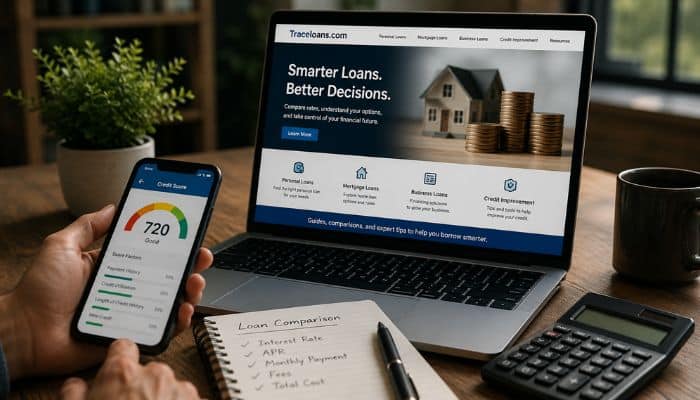

Traceloans.com can be useful for readers who want to understand borrowing before making a financial decision. Borrowing money can help during emergencies, education, business needs, home repairs, debt consolidation, or major purchases. However, a loan can also create long-term financial stress when borrowers do not understand APR, interest rates, repayment terms, fees, credit impact, privacy risks, and lender legitimacy.
Traceloans.com appears to focus on loan education, borrower guidance, personal loans, mortgage loans, business loans, rate comparison, and credit improvement. Its homepage describes the site as providing guides on personal, mortgage, and business loans, with support for comparing rates and improving credit.
This Traceloans.com loan education guide explains how smart borrowers can compare loan options, understand APR, check credit reports, verify lenders, protect personal data, avoid loan scams, and decide whether borrowing is truly the right choice.
How We Researched Traceloans.com
To create this Traceloans.com guide, we reviewed the visible website content, borrower search intent, finance-related safety concerns, and official consumer protection guidance.
Our research focused on:
- What Traceloans.com appears to offer readers
- Whether the site looks like a lender, broker, or education resource
- How borrowers should compare loan offers before applying
- How APR, fees, and repayment terms affect total borrowing cost
- How credit history can influence approval and pricing
- How to verify a lender before sharing sensitive data
- How to identify advance-fee loan scams and unsafe offers
This matters because loan-related content affects money, credit, privacy, and financial security. A strong finance article should avoid overpromising and help readers make careful, informed decisions.
What Is Traceloans.com?
Traceloans.com is best understood as a loan education and borrower guidance website. It appears to help readers learn about loan types, rate comparison, credit improvement, debt management, and smarter borrowing habits.
A smart borrower can use Traceloans.com as a starting point before comparing real loan offers. However, readers should not assume that the site directly approves, funds, or services loans unless this is clearly confirmed through official disclosures.
The best way to use the site is simple:
- Learn the basics
- Compare real lender offers
- Verify the lender
- Read the loan agreement
- Protect personal data
- Borrow only if repayment is affordable
Traceloans.com Website Snapshot 2026
| Website Area | What It Means for Borrowers |
|---|---|
| Personal loan education | Helps readers understand unsecured borrowing, APR, fees, and repayment |
| Mortgage loan guidance | Useful for readers learning about home loan options |
| Business loan content | Helps entrepreneurs understand financing choices |
| Rate comparison topics | Encourages borrowers to compare loan costs |
| Credit improvement guidance | Explains why credit history matters before applying |
| Debt management education | Helps readers plan repayment and avoid unmanageable debt |
| Loan safety awareness | Encourages readers to avoid rushed or risky decisions |
This snapshot shows that Traceloans.com may be useful for beginners, but the final decision should always depend on verified lender details, official disclosures, and personal repayment ability.
Is Traceloans.com a Lender, Broker, or Loan Education Website?
One of the most important questions readers ask is whether Traceloans.com gives loans directly. Based on its visible content, the site appears to work mainly as a loan education and borrower guidance website rather than a confirmed direct lender.
This distinction matters because a lender funds loans, a broker may connect borrowers with lenders, and an education website explains loan topics. If any website sends users toward loan options or partner pages, borrowers should still verify the actual lender before sharing personal or financial information.
Before applying for any loan, check:
- Whether the lender is licensed
- Whether the company has a real business name
- Whether contact details are clear
- Whether APR and fees are shown in writing
- Whether repayment terms are explained
- Whether the lender asks for upfront payment
- Whether reviews show repeated complaints
- Whether the lender appears in official licensing databases
A smart borrower should treat Traceloans.com as a learning tool, not as a final financial decision-maker.
Who Should Use Traceloans.com?
Traceloans.com is most useful for people who want to understand loan basics before applying. It can help readers slow down and think carefully instead of choosing the first loan offer they see.
The site may be helpful for:
- First-time borrowers
- Personal loan shoppers
- Bad-credit borrowers
- Debt consolidation users
- Mortgage beginners
- Auto loan researchers
- Student loan researchers
- Small business owners
- People comparing loan rates
- Readers worried about loan scams
- Borrowers who want to understand APR and fees
The best reader for Traceloans.com is someone who wants education before action.
Why Loan Education Matters Before Borrowing
Many borrowers ask, “Can I get approved?” Smart borrowers ask, “Can I afford this loan safely?”
Loan education matters because it helps you understand:
- How interest increases total repayment
- Why APR is more useful than interest rate alone
- How origination fees can raise borrowing costs
- Why long repayment terms may cost more overall
- How credit history affects approval and pricing
- Why missed payments can damage credit
- How secured and unsecured loans differ
- When debt consolidation helps
- When a loan may create more financial pressure
The Consumer Financial Protection Bureau explains that APR is the interest rate plus certain additional fees charged with a loan, which makes APR one of the most important numbers to compare before choosing a loan.
How Traceloans.com Helps Smart Borrowers
The strongest use of Traceloans.com is education before action. Instead of applying for the first offer, borrowers can use the site to understand loan language and prepare better questions.
Traceloans.com can help readers:
- Learn common loan terms
- Understand personal, mortgage, and business loan differences
- Compare secured and unsecured loans
- Review credit score basics
- Think through debt management options
- Understand APR, fees, and loan terms
- Prepare questions before speaking with lenders
- Recognize when a loan offer may be risky
A smart borrower uses the site first for learning, then compares actual lender disclosures before applying.
Understanding the Basics of Loans
A loan is money borrowed from a lender with an agreement to repay it over time, usually with interest. The amount borrowed is the principal. The repayment period is the term. The total cost includes interest, fees, and other charges.
When reading any loan guide, borrowers should focus on:
- Loan amount
- Interest rate
- APR
- Monthly payment
- Loan term
- Origination fee
- Late payment fee
- Prepayment penalty
- Total repayment amount
- Collateral requirement
- Co-signer requirement
- Default consequences
The biggest mistake many borrowers make is looking only at the monthly payment. A lower payment may feel easier, but a longer term can increase the total amount paid.
APR vs Interest Rate: What Smart Borrowers Should Know
APR and interest rate are related, but they are not always the same. The interest rate shows the cost of borrowing the principal. APR gives a broader picture because it includes the interest rate plus certain fees. The CFPB also says both interest rate and APR are important measures of what borrowers pay for credit.
For example, one lender may advertise a lower interest rate but charge a higher origination fee. Another lender may show a slightly higher interest rate but fewer fees. The better deal depends on APR, repayment term, monthly payment, and total repayment cost.
Before accepting a loan, ask:
- What is the APR?
- Is the rate fixed or variable?
- What fees are included?
- Are any fees excluded from APR?
- What is the total repayment amount?
- Can I repay early without penalty?
- What happens if I miss a payment?
Use Traceloans.com to understand the terms, but always rely on official lender documents for final numbers.
Loan Calculator and Formula for Smart Borrowers
A loan calculator helps borrowers understand affordability before applying. Even a simple estimate can show whether the monthly payment fits your budget.
Monthly Payment Formula:
Monthly Payment = P × [r(1 + r)^n] / [(1 + r)^n − 1]
Where:
- P = loan principal
- r = monthly interest rate
- n = number of monthly payments
| Loan Detail | Example |
|---|---|
| Loan amount | $5,000 |
| APR estimate | 12% |
| Monthly interest rate | 1% |
| Loan term | 36 months |
| Estimated monthly payment | About $166 |
| Estimated total repayment | About $5,976 |
| Estimated interest cost | About $976 |
This is only an estimate. Real payments may change because of fees, compounding rules, variable rates, and lender-specific charges. Still, this section makes the guide more practical because readers can move from loan theory to real planning.
Types of Loans Smart Borrowers Should Compare
Different loans serve different needs. Before choosing one, borrowers should understand how each option works.
| Loan Type | Best For | Main Risk |
|---|---|---|
| Personal loan | Emergencies, planned expenses, debt consolidation | High APR if credit is weak |
| Secured loan | Borrowers with collateral | You may lose the asset if you default |
| Unsecured loan | Borrowers without collateral | Higher rates and stricter approval |
| Auto loan | Buying a new or used vehicle | Long terms may increase total cost |
| Mortgage loan | Buying or refinancing a home | Long-term debt and closing costs |
| Student loan | Education expenses | Repayment may last many years |
| Business loan | Startup or business growth | Revenue uncertainty can affect repayment |
| Debt consolidation loan | Combining multiple debts | Can backfire if spending habits do not change |
A loan should match your purpose, income, repayment ability, and risk level.
Credit Education for Smart Borrowers
Credit education is one of the most important parts of borrowing. Traceloans.com can help readers understand why credit history matters, but borrowers should also check official credit information.
FICO says scores are calculated using credit report data grouped into five categories: payment history, amounts owed, length of credit history, new credit, and credit mix. Payment history and amounts owed carry the largest weighting in the FICO model.
Before applying for a loan, smart borrowers should:
- Check credit reports for errors
- Pay bills on time
- Reduce high credit card balances when possible
- Avoid unnecessary hard inquiries
- Keep older accounts in good standing
- Review collections or late payments
- Understand debt-to-income ratio
- Build a repayment plan before borrowing
Borrowers should use official credit report sources when checking their credit history. This helps them review possible errors before applying for a loan.
Bad Credit Borrowing Guide
Bad credit does not always mean you cannot borrow, but it often means borrowing becomes more expensive. This is where Traceloans.com can help with education, but borrowers need extra caution.
If you have bad credit, lenders may:
- Charge a higher APR
- Offer a smaller loan amount
- Require collateral
- Require a co-signer
- Add stricter repayment terms
- Deny the application
- Offer only short-term or high-cost products
Bad-credit borrowers should:
- Check credit reports first
- Correct inaccurate negative items
- Compare at least three lenders
- Ask credit unions about lower-cost options
- Avoid guaranteed approval claims
- Avoid upfront payment requests
- Consider a co-signer only when both people understand the risk
- Use secured loans only if the asset is protected
- Consider nonprofit credit counseling if debt is unmanageable
Easy approval should never replace careful verification.
Example: How a Smart Borrower Uses Traceloans.com
Imagine a borrower with fair credit needs $5,000 for urgent home repairs. Instead of applying immediately, they use Traceloans.com to understand APR, repayment terms, origination fees, lender verification, and total borrowing cost.
Then they check their credit report, compare several offers, review total repayment costs, and confirm whether each lender is licensed. That simple process can help the borrower avoid rushed decisions and choose a loan that fits the budget instead of only looking at the lowest monthly payment.
Documents Needed Before Applying for a Loan
Preparing documents early can make the loan process smoother. After learning from this loan education resource, borrowers should collect important documents before applying.
| Document | Why Lenders May Ask for It |
|---|---|
| Government-issued ID | Confirms identity |
| Proof of address | Confirms residence |
| Pay stubs | Shows employment income |
| Bank statements | Shows cash flow |
| Tax returns | Useful for self-employed borrowers |
| Credit report | Helps review credit history |
| Debt list | Helps calculate debt-to-income ratio |
| Employment details | Confirms work stability |
| Business financials | Needed for business loans |
| Collateral documents | Needed for secured loans |
Do not upload sensitive documents to an unknown website. Verify the lender first, then share information only through secure and official channels.
Borrower Checklist Before Choosing a Loan
Use this checklist while reading Traceloans.com and comparing real loan offers.
| Question | Why It Matters |
|---|---|
| Do I truly need this loan? | Prevents unnecessary debt |
| Can I afford the monthly payment? | Reduces default risk |
| What is the APR? | Shows the broader borrowing cost |
| Are there upfront or hidden fees? | Helps identify expensive offers |
| Is the lender licensed? | Helps avoid risky lenders |
| Is the rate fixed or variable? | Prevents payment surprises |
| What is the total repayment amount? | Shows the real cost |
| Can I repay early without penalty? | Gives repayment flexibility |
| What happens if I miss a payment? | Shows default consequences |
| Did I compare multiple offers? | Improves decision quality |
A borrower who uses this checklist is less likely to choose a loan based only on advertising.
How to Verify a Lender Before Applying
This is one of the most important safety steps. Traceloans.com can explain loan topics, but you must verify the actual lender before sharing private information.
NMLS Consumer Access is a searchable website that allows the public to view information about state-licensed companies, branches, and individuals. The CFPB also says NMLS can help consumers check whether a financial-services company or professional is authorized to conduct mortgage-related business in their state.
Before applying, check:
- Legal business name
- State license or registration
- NMLS ID when applicable
- Physical address
- Customer support details
- Privacy policy
- Loan disclosures
- Complaint history
- Secure HTTPS website
- Pressure tactics or unrealistic claims
If the lender name on the website does not match official records, pause and investigate.
Warning Signs Smart Borrowers Should Never Ignore
Scam lenders often target people who need money quickly. The FTC warns that some companies promise a loan or credit card regardless of credit history but require a processing fee or other upfront payment first; those offers are scams.
Watch for these red flags:
- Guaranteed approval with no real review
- Upfront payment before loan release
- Requests for gift cards, crypto, wire transfers, or payment apps
- Pressure to act immediately
- No clear company address
- No written loan agreement
- Vague APR or fee details
- Fake government or bank branding
- No privacy policy
- Requests for sensitive data before verification
- Claims that credit history does not matter at all
A smart borrower can use Traceloans.com to learn loan basics, but scam prevention requires independent verification.
Complaint and Scam Reporting Section
If you believe a lender, broker, or loan website has misled you, document everything. Save screenshots, emails, contracts, payment receipts, phone numbers, URLs, and names of people you spoke with.
You can report problems through:
- FTC for scams, fraud, and advance-fee loan concerns
- CFPB for consumer financial product complaints
- State attorney general for local consumer protection issues
- State banking or financial regulator for lender licensing concerns
- NMLS Consumer Access for mortgage-related license verification
- Your bank or card issuer if you sent money or shared account details
The CFPB accepts complaints about consumer financial products, including credit reports, debt collection, mortgages, payday loans, personal loans, student loans, vehicle loans, and other financial services.
Privacy and Data Safety Checklist
Loan applications involve sensitive information, so privacy matters. Before sharing data after reading Traceloans.com or any loan guide, confirm that you are dealing with a legitimate company.
Protect yourself by following this checklist:
- Do not share your Social Security number with an unverified site
- Do not upload ID documents before checking the lender
- Do not provide online banking passwords
- Do not send money to unlock a loan
- Do not share debit card PINs
- Do not use public Wi-Fi for loan applications
- Check whether the website uses HTTPS
- Read the privacy policy before submitting forms
- Use strong passwords and two-factor authentication
- Watch for phishing emails after requesting loan information
- Freeze or monitor credit if your information was exposed
Loan education can help you make better decisions, but data safety depends on where and how you apply.
Debt Consolidation: Helpful Tool or Risky Shortcut?
Debt consolidation can help when it combines several high-interest debts into one lower-cost loan. It can simplify repayment and may reduce interest. However, it can also create new problems if the borrower keeps using old credit cards or accepts a longer term that increases total interest.
Before using this loan education resource to research debt consolidation, ask:
- Will the new loan lower my APR?
- Will it reduce my total repayment cost?
- Can I afford the new monthly payment?
- Are there origination fees?
- Will I stop using old debt accounts irresponsibly?
- Is the repayment term too long?
- Am I solving the cause of debt or only moving it?
Debt consolidation works best when it is part of a larger repayment plan.
Loan Alternatives Before Borrowing
A loan is not always the best answer. Smart borrowers compare alternatives before taking on new debt.
| Alternative | Best For | Caution |
|---|---|---|
| Emergency savings | Small urgent expenses | May reduce your safety cushion |
| Payment plan | Medical bills, utilities, service providers | Get terms in writing |
| Credit union small loan | Lower-cost borrowing | Membership may be required |
| Balance transfer card | Credit card debt with good credit | Watch transfer fees and promo deadlines |
| Nonprofit credit counseling | Serious debt stress | Choose reputable nonprofit agencies |
| Hardship program | Temporary income loss | Ask creditor before missing payments |
| Budget adjustment | Non-urgent expenses | Requires spending changes |
| Selling unused items | Small cash needs | Not a long-term solution |
| Family loan | Short-term support | Put terms in writing |
Borrowing should solve a problem, not create a bigger one.
When a Loan May Not Be the Right Choice
Even after reading Traceloans.com, some borrowers should pause before applying. A loan may not be right if:
- You cannot afford the monthly payment
- You are borrowing to repay another unaffordable loan
- The lender asks for upfront fees
- You do not understand the agreement
- Your income is unstable
- You are using debt for lifestyle spending
- The APR is extremely high
- You feel pressured to apply immediately
- You have not compared other options
- You have no repayment plan
A smart borrower knows that approval is not the same as affordability.
Traceloans.com Pros, Cons, and Best Use Cases
| Category | Details |
|---|---|
| Pros | Beginner-friendly loan education, debt management coverage, credit report topics, and consumer loan guidance |
| Cons | Should not replace official lender disclosures or professional advice |
| Best use case | Learning loan basics before applying |
| Not ideal for | Making a final borrowing decision without comparing real lender offers |
| Smart borrower tip | Use the site for education, then verify lender licensing and compare APRs |
This balanced view helps readers understand both the benefits and limitations of Traceloans.com.
How to Compare Loan Offers Like a Smart Borrower
After using the site for basic loan education, compare actual lender offers side by side. For mortgage borrowers, the CFPB recommends comparing Loan Estimates from multiple lenders because this helps borrowers choose the loan that fits them best.
| Lender | Loan Amount | APR | Term | Monthly Payment | Fees | Total Repayment |
|---|---|---|---|---|---|---|
| Lender A | $5,000 | 12% | 36 months | Check offer | Check offer | Check offer |
| Lender B | $5,000 | 15% | 24 months | Check offer | Check offer | Check offer |
| Lender C | $5,000 | 10% | 60 months | Check offer | Check offer | Check offer |
Do not choose only the lowest monthly payment. Choose the loan with the best balance of affordability, total cost, lender trust, and repayment flexibility.
Common Mistakes Borrowers Make
Borrowers often make mistakes when they are rushed, stressed, or confused. Traceloans.com can help reduce confusion, but borrowers still need discipline.
Avoid these mistakes:
- Borrowing more than needed
- Ignoring APR
- Accepting the first offer
- Focusing only on monthly payment
- Missing origination fees
- Choosing a long term without checking total cost
- Applying to too many lenders without a plan
- Trusting guaranteed approval claims
- Not checking credit reports first
- Not verifying lender licensing
- Sharing sensitive data too early
- Borrowing for non-essential spending
Research Limitations
This Traceloans.com guide is based on publicly visible website information, loan education topics, and official consumer protection sources. It does not claim that the site is a lender, broker, or financial institution unless that is clearly confirmed by official disclosures.
Readers should verify:
- Company ownership
- Lender relationships
- Licensing details
- Privacy policy
- Loan disclosures
- Partner lender terms
- Complaint history
- Current website updates
This limitation section is important because finance content should avoid overclaiming. Smart borrowers should use Traceloans.com for education, but they should verify every actual lending decision separately.
Is Traceloans.com Useful for Smart Borrowers?
Yes, Traceloans.com can be useful for smart borrowers who want to learn before applying. It appears to cover loan education, personal loans, mortgage loans, business loans, rate comparison, credit improvement, and borrower guidance. Its strongest value is helping readers understand loan concepts in a simpler way.
However, Traceloans.com should not replace professional advice, official lender disclosures, or lender verification. Smart borrowers should use it as the first step in learning, not the final step in choosing.
The best approach is:
- Learn the basics with Traceloans.com
- Check your credit report
- Compare multiple lenders
- Verify lender licensing
- Review APR, fees, and repayment terms
- Protect your personal data
- Borrow only if the payment fits your budget
Conclusion
Borrowing money can help in the right situation, but it can also create long-term stress if handled poorly. A smart borrower does not rush because a website, advertisement, or lender says approval is easy. A smart borrower studies the loan type, checks credit, compares APR, reviews fees, verifies the lender, and plans repayment before accepting money.
Traceloans.com can be a helpful education resource for people who want to understand loans before applying. It can guide readers through loan basics, credit improvement, rate comparison, debt management, and safer borrowing habits. But the responsibility for the final decision still belongs to the borrower.
Use Traceloans.com to become informed, use official sources to verify, and use comparison tables to calculate cost. The smartest loan is not always the fastest or easiest loan. It is the loan you understand, can afford, and can repay without hurting your financial future.
Traceloans.com FAQs
1. Is Traceloans.com useful for first-time borrowers?
Yes. Traceloans.com can help first-time borrowers understand basic loan terms, APR, repayment risks, and lender verification before applying.
2. Does Traceloans.com explain secured and unsecured loans?
Traceloans.com may help readers understand the difference between secured loans that require collateral and unsecured loans that do not.
3. Can Traceloans.com help borrowers avoid overborrowing?
Yes. Traceloans.com can guide borrowers to compare loan amounts, repayment terms, and affordability before taking more debt than needed.
4. Is Traceloans.com helpful for debt consolidation research?
Traceloans.com can be useful for learning debt consolidation basics, but borrowers should compare APR, fees, and total repayment cost carefully.
5. Can small business owners use Traceloans.com?
Yes. Traceloans.com may help small business owners understand business loan basics, repayment planning, and lender comparison points.
6. Does Traceloans.com help explain loan fees?
Traceloans.com can help readers understand common loan fees such as origination fees, late fees, and possible prepayment penalties.
7. Should I use Traceloans.com before choosing a lender?
Yes. Traceloans.com can be used as an educational starting point before comparing lenders, checking licenses, and reviewing loan disclosures.
Disclaimer
This article is for educational and informational purposes only. It is not financial, legal, tax, or lending advice. Readers should verify lender details, review official loan disclosures, and consult a qualified professional before making any borrowing decision.
